


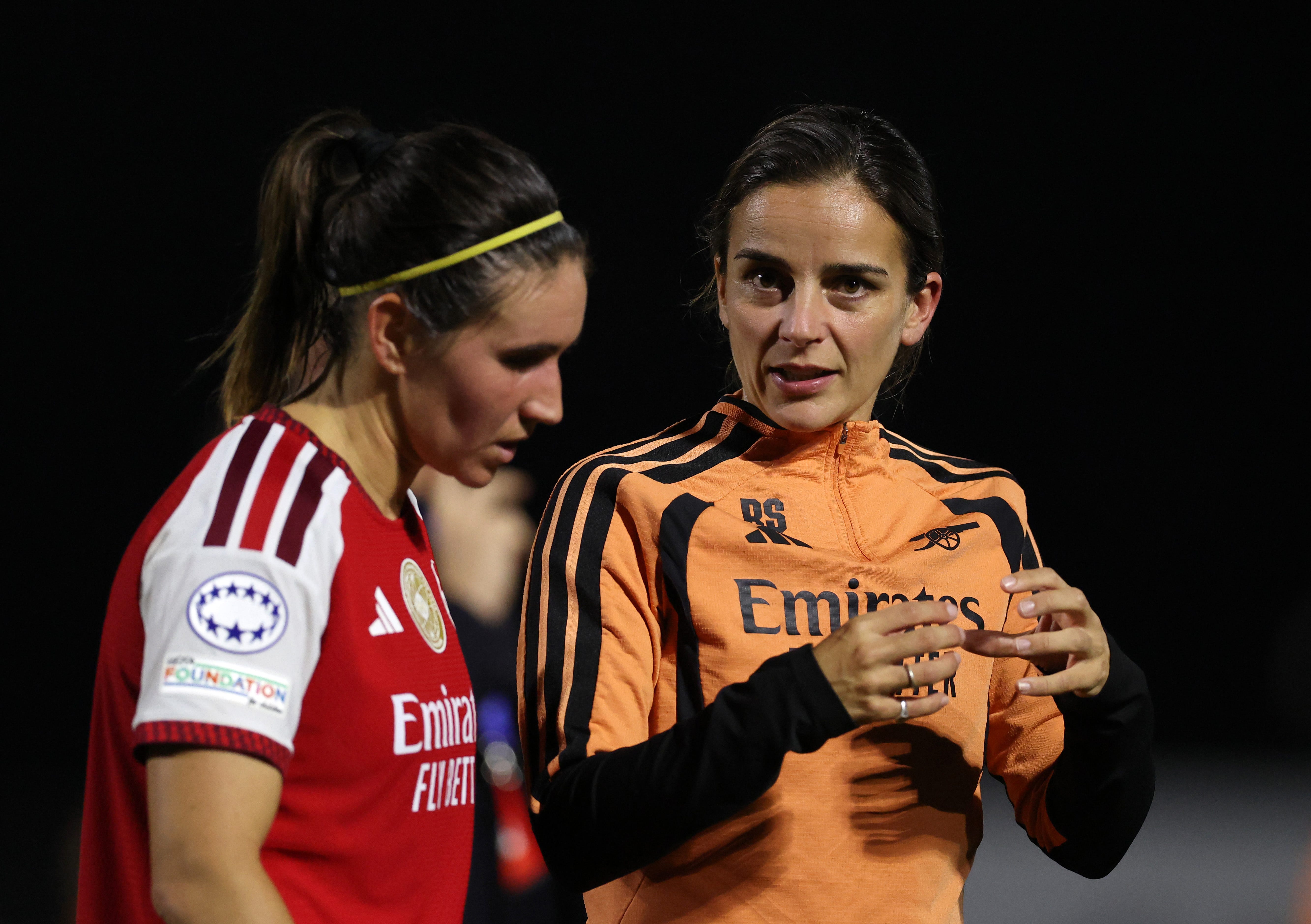
As the clock ticked into injury time of Arsenal’s opening Women’s Champions League fixture, the Gunners were toiling once again. Renée Slegers had made eight changes against part-timers HB Køge, trying to make full use of a squad so deep that some players had struggled even to make the bench in Arsenal’s opening three WSL matches.
Slegers would have hoped to rest the likes of Alessia Russo, Mariona Caldentey, Olivia Smith and Lisa Baum against the Danish minnows. Instead, the prospect of a third consecutive match without a win left her with little choice but to call on the cavalry.
Even then, summer signing Selina Cerci proved to be the difference-maker. Limited to just 19 minutes across Arsenal’s opening three WSL matches, the former Hoffenheim forward won an injury-time penalty that Mariona just about converted despite the best efforts of Alberte Vingum in the Køge goal.
The three points may prove important with tougher Champions League fixtures to come, but make no mistake: this was a performance that posed more questions than answers for an Arsenal side whose season is already in danger of spiralling out of control.
Before the penalty, Arsenal had created just 1.2 xG. Their performance was largely characterised by an inability to move the ball quickly, particularly in the final third. Arsenal recorded a field tilt of 89%, meaning they enjoyed an overwhelming share of the two teams’ final-third possession, but once again struggled to turn territorial dominance into meaningful chances.
It’s true that Arsenal have underperformed their xG to an unusual degree in the WSL, something The Cutback highlighted after Saturday’s draw with Manchester United. But the quality and volume of their chance creation also leave room for improvement.
The Gunners are averaging 1.9 xG per 90 minutes in the league, a perfectly respectable figure in isolation. It pales, however, in comparison with Chelsea and Manchester City, who are averaging 3.5 and 3.4 respectively. Arsenal’s finishing has undoubtedly been poor, but that has compounded rather than created the problem.
Their next two WSL matches come away to those same title rivals and we will soon get a much clearer idea of whether a genuine gap exists between Arsenal and the teams they hope to challenge, and how significant it might be.
Given how badly Slegers’ side continued to struggle against Køge, it would be tempting to conclude that those brought into the team failed their auditions ahead of Sunday’s huge WSL meeting with Chelsea at Stamford Bridge.
That is probably fair in terms of Arsenal’s attackers. Caitlin Foord was withdrawn after an hour, Frida Maanum completed just 71% of her passes and Stina Blackstenius, who missed chances against Manchester United, recorded only 15 touches and was dispossessed five times.
Kyra Cooney-Cross made a much stronger case for inclusion. The Australian midfielder was denied an early assist for Chloe Kelly after a VAR intervention but went on to be named player of the match by Uefa. Out of contract at the end of the season, Cooney-Cross brought an energy and incisiveness to midfield that Arsenal otherwise lacked.
Her passing range was particularly eye-catching. She completed nine long passes, while her 10 progressive passes were more than any other Arsenal player managed on the night.
Cooney-Cross had already been one of Arsenal’s more impressive performers against Crystal Palace and will have been disappointed not to feature in the draw with Manchester United, when Arsenal badly needed more zip and impetus on the ball.
Supporters are increasingly clamouring to see more of one of the club’s few bright sparks this season. If Cooney-Cross cannot earn a starting place against Chelsea after another strong performance, questions will inevitably follow about how Slegers is rewarding form with her team selections.
Beyond the individual performances, there is only so much Arsenal can take from the game against Køge. For all their struggles against low blocks this season, Chelsea will present a completely different challenge.
Previous meetings between Slegers and Sonia Bompastor have been defined by tactical mini-battles, with momentum shifting as each coach adjusts across the 90 minutes. Those contests have generally made for far more compelling tactical viewing than the attack-versus-defence exercises Arsenal’s last three matches have resembled.
Stamford Bridge has also become something of a happy hunting ground for Arsenal in 2026.
Their January visit to west London brought a first WSL away win against Chelsea in eight years. April’s controversial Champions League quarter-final was then a case of glorious defeat, with a 1-0 loss on the night enough to send the Gunners through on aggregate.
That was Arsenal’s only defeat in four meetings with Chelsea last season, and they desperately need that strong recent record against their London rivals to continue on Sunday.
On paper, this may be one of Arsenal’s toughest matches of the season. It is not, however, a free hit. Another stuttering start to a WSL campaign means Arsenal, and perhaps more pertinently Slegers, simply cannot afford to fall further behind in the title race.
