Business of Women's Football Insider: The Champions League's marketing problem, and another NWSL attendance record smashed
The inside track on all the big deals and business stories from across women's sport

Welcome to the latest edition of The Cutback’s Business of Women’s Football Insider newsletter.
This is where we fill you in on all the big deals and headline moments from the previous month, including media rights, sponsorship and more.
In this month’s issue: Summit break records, UWCL marketing issues, a new Mercury13 club and NWSL expansion
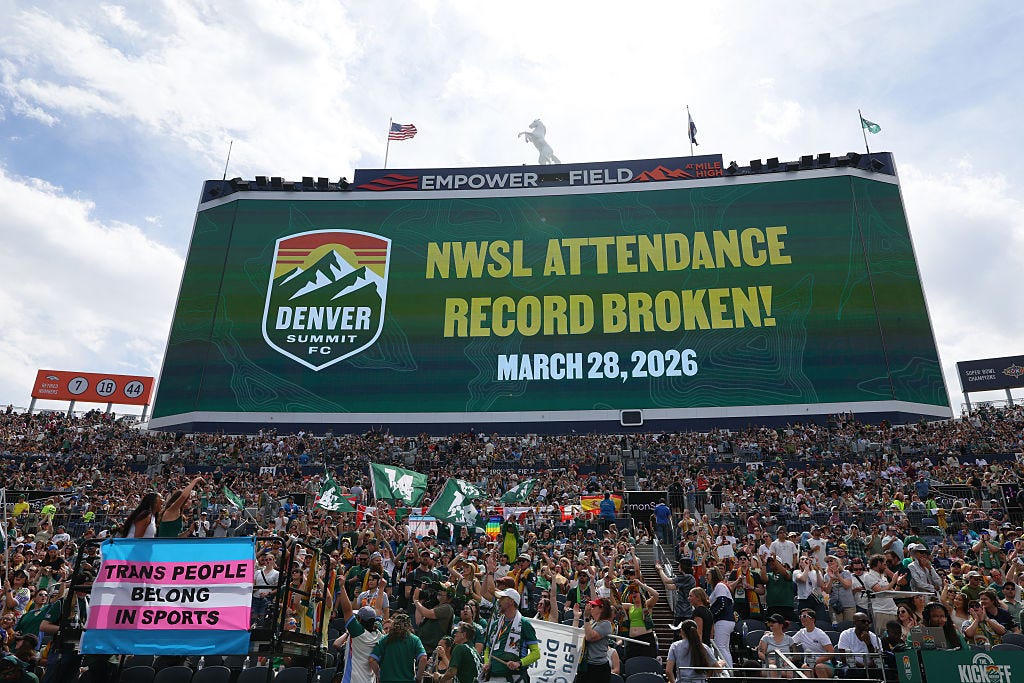
1. NWSL attendance record smashed at Summit’s home opener
Matchday attendance could be the most important business metric in women’s club football right now.Broadcast rights deals in women’s football offer cents on the dollar compared to the men’s game and are locked in for years, making short-term revenue growth almost impossible unless additional deals are struck.
Sponsorship is often measured as by far the most important revenue stream for clubs in Europe, but as long as revenue is allocated from club-wide sponsorship deals, nobody will ever really know how much these clubs would earn as independent organisations.
Matchday attendance and revenue is the single biggest growth opportunity for most women’s football clubs, as well as being the purest measure of a club’s commercial success and potential. If a club or competition is drawing fans to leave their house and spend money, they’re almost certainly drawing more television viewers, more eyeballs on socials, and thus more sponsorship cash.
That’s why the home attendances for the NWSL’s two expansion teams – the Denver Summit and Boston Legacy – are massively encouraging for the league. The Denver Summit smashed the league’s attendance record at their first home game on March 27 by drawing over 63,000 fans to Empower Field, while the Boston Legacy drew over 30,000 to Gillette Stadium for their home opener on 14 March.
The Summit and Legacy have likely set high watermarks for their seasons, given these games were high-profile events played at their cities’ respective NFL stadiums.
The Summit will play the rest of the season at the wonderfully-named Dick’s Sporting Goods Park, which usually hosts the Colorado Rapids of Major League Soccer. The Legacy will play a total of six home fixtures at Gillette Stadium before a summer run at Centreville Bank Stadium, home to the United Soccer League’s Rhode Island FC.
The Legacy’s second home game at Gillette Stadium pulled in just over 10,000 fans – an amount that would fill their White Park stadium that will be in use from the 2027 season onwards.
If the Summit and Legacy can average anywhere close to 10,000 fans over the course of their first NWSL seasons, it would immediately put them at the league average. That, more than any sponsorship allocation or broadcast rights allocation, will prove the Summit and Legacy are viable sports businesses.
2. Does the UWCL have a marketing problem in England?
Alarm bells should be ringing at Uefa about the fact their premium women’s club competition isn’t cutting through in England.
Attendance figures did not look good for the first leg of the quarter-finals compared to WSL fixtures. Arsenal drew 18,087 for their Women’s Champions League quarter-final first leg against Chelsea at the Emirates on 24 March. Three days later, they attracted 46,123 fans for the north London derby against Tottenham in the WSL.
Likewise, Manchester United drew 7,513 for their quarter-final first leg against Bayern Munich at Old Trafford on 25 March, only to attract 24,983 fans for the WSL Manchester derby at Old Trafford on the following Saturday.
A couple of things went in favour of those WSL games. Both were played during a men’s international break, which always helps boost attendances and viewing figures. The games were also played during the day on weekends, which helps attract families with young kids.
However, neither of those mitigating factors should entirely save Uefa’s blushes. There are no circumstances in which anyone should be happy with Manchester United playing a Champions League quarter-final at Old Trafford that draws just a third of the following weekend’s crowd.
Luckily for Uefa, the problem is largely confined to England. Bayern Munich broke their attendance record for the second leg against United as 25,000 fans attended the Allianz Arena to see their side go through to the semi-finals. Meanwhile, Barcelona’s home leg against Real Madrid drew over 60,000 fans at the Camp Nou, the highest attendance at the stadium for a men's or women’s game since it reopened in November.
Much of this has to do with Uefa’s choice of broadcast partners – previously DAZN and now Disney+. DAZN enjoyed widespread distribution in Spain and Germany as it has been a primary broadcaster for LaLiga and the Bundesliga over the past several years. In the UK, however, it has been little more than a niche boxing streaming service.
Now, with Disney+ showing the majority of matches, the UWCL continues to be hidden from UK audiences aside from the hardest of the hardcore that have subscribed specifically for the competition.
A free-to-air window each matchweek seems to be doing very little to help the UWCL’s case and, likely due to poor viewing figures, UWCL matches have been finding their way onto YouTube in a bid to get more exposure for the competition.
Fans have also seen billboard advertisements pop up around grounds that hosted quarter-final fixtures, a move that feels a little bit too little too late. Not only did the ads target fans that already going to the match and not watching at home, but they’ve arrived when the competition is at its halfway point. This has also been followed with the first digital ads that Disney have delivered with tie-ins across Stick to Football and other podcasts on social media.
It’s too late to change things for this season, but Uefa needs to figure out how to get these matches in front of English audiences. At present, the UWCL looks to be an afterthought for the majority of match-going fans.
3. Mercury13 moves into Spain with Badalona Women deal
Mercury13’s majority investment in FC Badalona Women showed the group is still in motion after the departure of co-founder Victoire Cogevina Reynal.
The multi-club ownership group bought a controlling stake in FC Badalona, taking its multi-club network into Spain after earlier moves into Italy’s FC Como Women and England’s Bristol City. Badalona is a women’s only football club that was formally reorganised into a public sports company last year after attempting to relocate. Disputes with local municipalities over stadium lease agreements led to the club playing the 2025-26 season 100km away on the Costa Brava.
Mercury13’s announcement on March 10 said that these issues were now settled and that the club would move into the Estadi Municipal de Badalona from the 2026-27 season after renovation works are completed. Ticketing and events portal Fever will become the club’s front-of-shirt sponsor, with Nike acting as kit supplier.
Mercury13 also said former Fifa and Olympique de Marseille executive Pedro Iriondo would join as chief executive of the club, while Lauren Holiday, now chairwoman of Mercury13, would join the board.
4. NWSL expansion process rumbles on towards 18th team
The NWSL’s expansion process gathered pace in March with an announcement that the league expects to reveal its 18th team this year, with a 2028 launch date. League commissioner Jessica Berman said that “a dozen or so” ownership groups were in talks over investing in a new franchise. The Associated Press reported the same week that the league plans to award the franchise this year, with the 2028 launch aligned to the beginning of its next domestic media rights deal.
The team is likely to land somewhere in Ohio, with Sports Business Journal’s report on 27 March detailing a bid to place the franchise in Columbus. The proposed Columbus group is led by Haslam Sports Group, owners of the NFL’s Cleveland Browns and Major League Soccer’s Columbus Crew. The bid proposes that the team would place at a ‘soccer-specific stadium’, with a training facility at McCoy Park.
The bid also seeks around $50 million in taxpayer money for that facility, as is tradition for billionaire sports team owners in the US.
5. TransferRoom launches women’s marketplace
TransferRoom, a football player-trading marketplace used by smaller clubs and agents, launched a women’s football edition in March.
Sports Business Journal reported that the platform had signed about 50 clubs worldwide within its first 20 days and had already landed its first league-wide agreement with the USL Super League. Clubs signed up to the platform can access squad lists with contract information and projected transfer valuations, and can also make players available for loan or permanent transfer via the platform. SBJ also reported that agencies were due to be added in April.
TransferRoom’s growth in men’s football has largely taken place at lower levels of the game or in more obscure leagues and markets where communication and information is scarce. Women’s football is similar to lower-league men’s football in many ways, with fewer specialised staff and weaker inter-club networks.
The early club sign-up figure suggests there is early demand for a more formalised player marketplace, especially in smaller nations and at lower levels. Just don’t expect NWSL and WSL clubs to flood the platform.


