



After Arsenal’s 4-2 loss to WSL champions Manchester City at the start of this month, head coach Renée Slegers put her side’s poor start to the season down to the “margins” between Arsenal’s dominance in games and the results they were producing.
As November beckons, nothing has changed in that regard. Arsenal have just one win from their opening six games of the season – a 1-0 victory over Brighton on the opening weekend – and since then, they have picked up three league points, with two of those coming in draws against newly promoted sides.
The Gunners are looking to turn their fortunes around against Tottenham in the north London derby on Saturday afternoon, and Slegers seemed adamant about continuing Arsenal’s current possession-heavy method, which has often been criticised as lacking purpose and tempo.
Asked to define Arsenal’s style of play in her pre-match press conference on Friday, Slegers said: “I think how we look to dominate in possession; we look to be unpredictable and fluid with our positioning, we want to break lines, get a lot of bodies forward on the pitch when we attack, all those things. I think what you guys have seen is that we haven’t rewarded ourselves when we get into the final third with the final pass, the final cross, the final finish.”
The Gunners are up there with title contenders City and Chelsea in terms of possession, with all three teams enjoying roughly 63% of the ball over their first six games. However, according to Opta, Arsenal aren’t doing very much good with it.
Slegers’ team have the worst shot conversion rate (4.1%) in the WSL, despite taking the third most shots (121). They have the third-worst shooting accuracy at around 30%, and the third-lowest average xG per shot (0.09) in the league.
These numbers indicate that Slegers’ side aren’t creating quality chances, and end up drifting away from their goals of being “unpredictable”, “fluid” and trying to “break lines”. Instead, Arsenal are taking a lot of bad shots as they struggle to break down sides that are well prepared to stop them.
When Arsenal are able to craft a quality opportunity, they rarely take it. Slegers’ side have racked up 11 expected goals (xG) across their first six games, scoring only five times. Their total xG ranks below 12th-placed Brighton and their opponents on Saturday, Spurs.
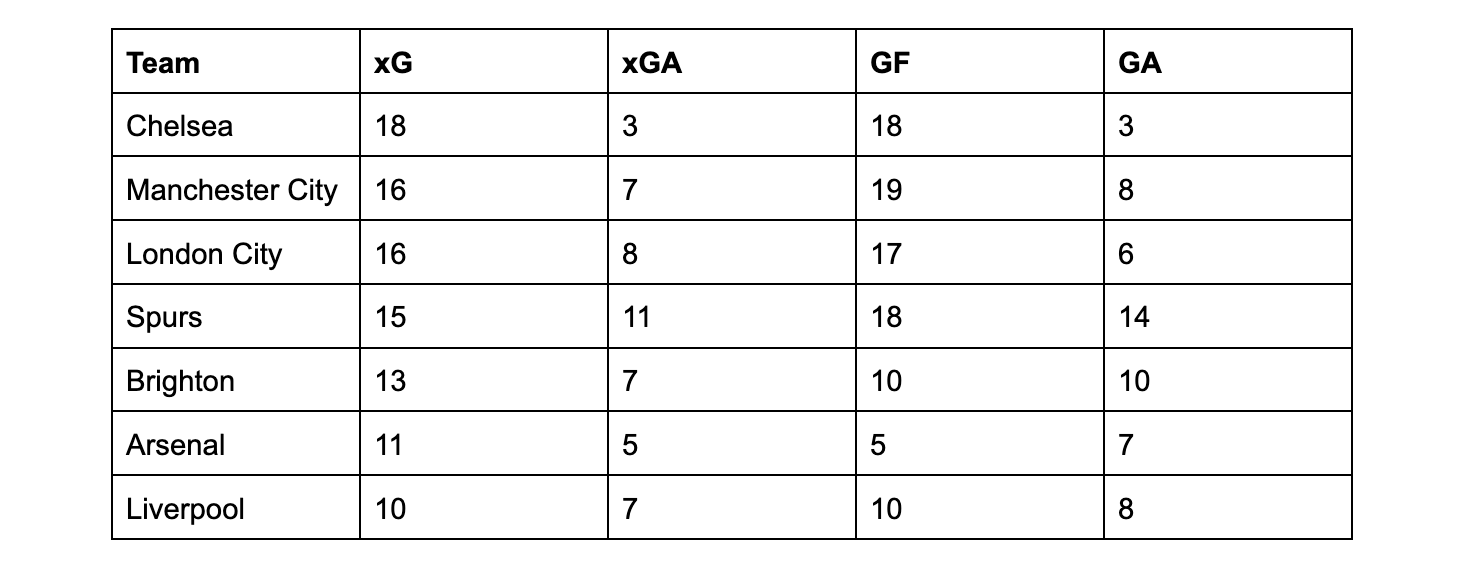
Slegers cannot necessarily control how wasteful Arsenal have been in front of goal this season, but her job is defined by her ability to influence the process of chance creation through changes to tactics, philosophy and personnel.
In last weekend’s 1-1 draw with Birmingham City, Slegers deployed the in-form Alessia Russo in the No 10 role to deputise for the injured Mariona Caldentey, with the out-of-form Stina Blackstenius starting up front. It’s a combination that Slegers has often deployed throughout her Arsenal tenure, but it has very rarely brought results.
New signings Geraldine Reuteler and Georgia Stanway are both capable of playing more attacking midfield roles, however Slegers opted to move Russo away from her favoured position and away from goal – despite Russo being in a rich vein of scoring form. The England striker had scored five in her last four games for club and country heading into last Saturday’s game.
It’s one of several instances of Russo being moved around by Slegers this season, and it is showing up in her output. The 27-year-old has averaged around seven touches in the opposition box per 90 minutes this season, her lowest average since the 2023-24 campaign.
In her press conference, Slegers spoke of her side playing “faster” this season and that it was something they had worked on, specifically when facing low blocks or compact opposition. However the proof of that work is yet to be shown, and certainly doesn’t present itself in the data.
Arsenal have racked up the most final-third passes attempted (1,403) and completed (1,113) in the WSL so far this season, but have lacked any real cutting edge. This is still an Arsenal side that can move the ball around for fun, and the addition of Stanway – who has completed more final-third passes than any other WSL player – has cemented that part of their identity.
However, Arsenal find themselves stuck in front of teams, and cannot find a way to pull opposition defences out of their shape. These long phases of possession in an opponent’s third often results in the ball being crossed out of frustration rather than opportunity – Arsenal lead the league in crosses attempted, too.
The data and the eye test tell a very similar story about Arsenal this season, and the results of that are shown by the WSL league table.
Slegers said on Friday that she is “not looking at that table” and that she is taking things “game by game”. Each of those games comes with the hope that Slegers will finally be able to effect some positive changes on her team, and around 4,000 Arsenal fans will be in the away end at the Tottenham Hotspur Stadium willing her and her team on.
Slegers had to endure some booing after last week’s 1-1 draw. It’s unclear what would be the final straw to trigger her exit, but unless Arsenal can find that long-awaited spark on Saturday, we may find out sooner rather than later.