



Chelsea needed this.
Not simply the result, but the manner of it. After dominating Aston Villa on the opening day only to draw 1-1, despite creating enough chances to win comfortably, A disjointed Manchester United offered Chelsea the chance to turn it around under the spotlights and they did exactly that, winning 5-0 in a convincing all-round performance.
One good game cannot erase the questions that have followed Chelsea into the new campaign. Sonia Bompastor’s side still have to prove they can consistently take more of their chances, improve their shot selection, and show that the resilience that once defined this team remains intact.
Against United, Chelsea answered some of those questions. They did not answer all of them.
The first response: Chelsea looked like Chelsea again
Chelsea played from the opening minutes with the aggression and intensity that had been missing from some of their more frustrating performances. They pressed high, attacked the space behind United’s defensive line and repeatedly looked to progress vertically from the back towards their wide players.
Lauren James, playing in a free role up front, moved across the front line and made herself difficult to track. Behind her, Kaptein often started from the right but moved inside, allowing Carpenter to provide the width on that side. That structure helped Chelsea attack the spaces around United’s defensive line, with both wing-backs given freedom to advance from the start.
The opening goal reflected the approach. Bronze’s miscued ball forward didn’t deter Kaptein, who took advantage of United’s defence misreading the trajectory of the pass. She attacked the space before delivering for Nüsken, who made her now-familiar run into the box from midfield and finished like a striker.
Chelsea deserved the reward for a dominant start.
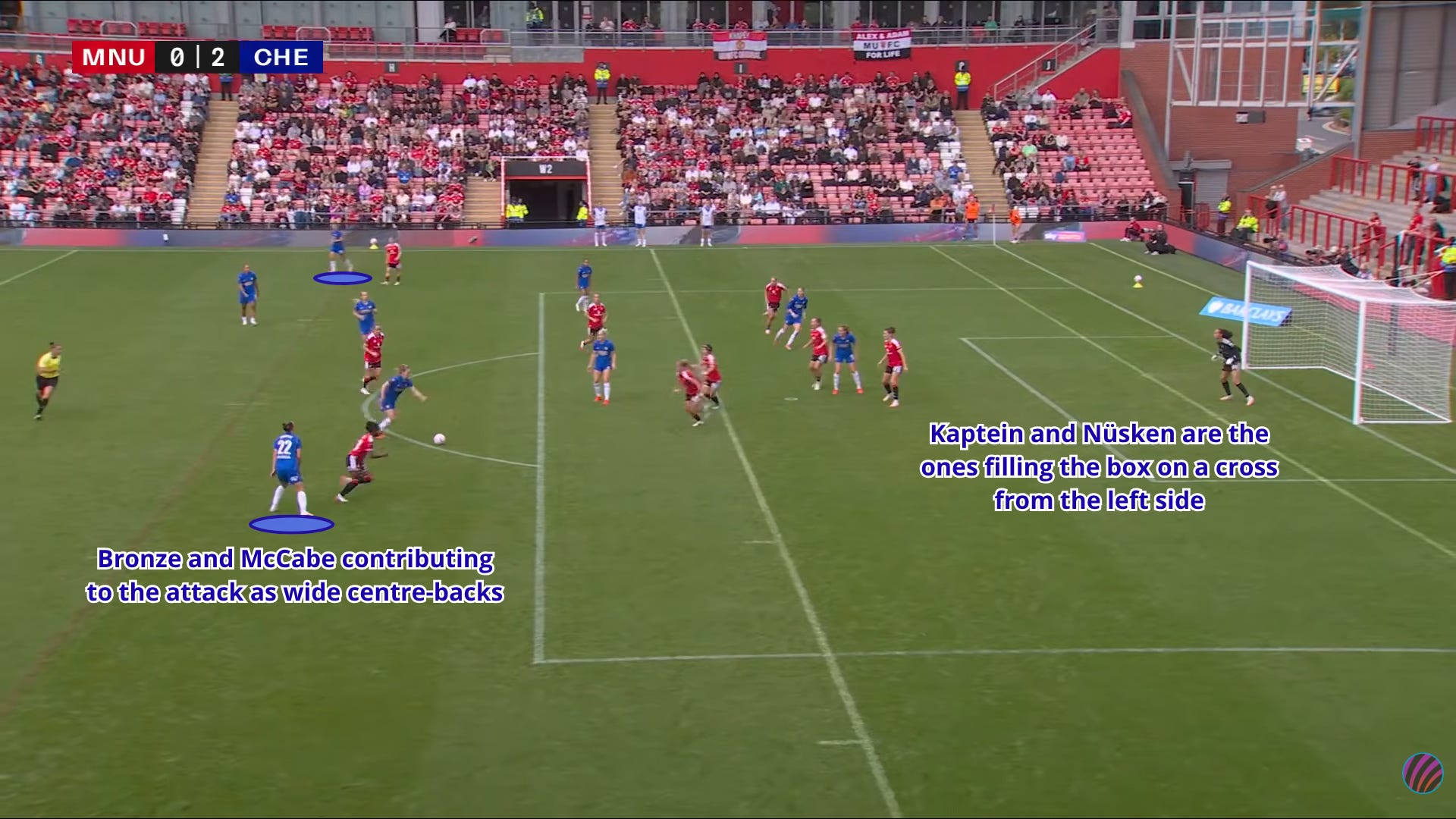
Chelsea settled into a 3-5-2 after taking the lead, with McCabe dropping alongside the centre-backs as the left-sided centre-back, Thompson and Carpenter pushed high as wing-backs, and Lexi Potter playing alongside Kiera Walsh in central midfield.
In possession, this almost became a 1-4-5, with the two wing-backs acting as wingers and the wide centre backs pushing up to link with Walsh and Potter in midfield.
Chelsea continued to press high and prevented United from establishing possession in their own half. That pressure eventually produced the second goal, as Bronze stepped out from the back three to win the ball high before finding Walsh on the edge of the box. The midfielder finished precisely into the bottom corner.
And once Chelsea had that cushion, something seemed to change. Their combinations became cleaner, particularly on the right, as if the weight of the previous week had finally been lifted.

