


Eva Olid’s first weeks as Manchester United head coach have brought plenty of challenges. After defeats to London City Lionesses and Chelsea in their opening WSL games, United were held to a 1-1 draw by Arsenal on Saturday, ending a difficult run with a performance that offered more encouragement, particularly out of possession. The early results have inevitably raised questions about how quickly Olid can reshape a side that is being asked to play in a very different way, but United are showing the key ideas of Olid’s style of football. The issue, understandably, is consistency in execution.
Building a team that plays through pressure
Olid's preferred structure at United has been a 4-2-3-1, a slight move away from the back-three system she used at Hearts, although the general football principles remain.
United generally build with the two central midfielders relatively close together and close to the defensive line, giving the centre-backs and goalkeeper short passing options. The aim is to circulate possession to attract the opposition press and then find the free player. Once the first line has been beaten, the team looks to accelerate. There is a clear preference for progressing the ball from outside to inside. The full-backs and left winger provide the width, but the ideal progression is often through the inside channels, with midfielders looking to find the attacking players between the lines or play diagonally beyond the defensive line.
Jess Park's right-wing role complements this well. She often moves into narrower positions, at times almost becoming an extra central midfielder, creating central density and another passing option between the lines.
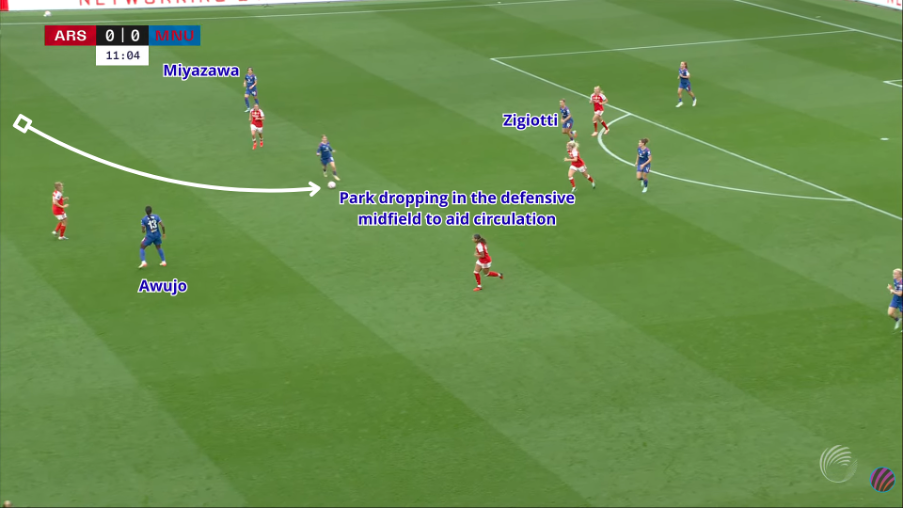
On the opposite side, the structure tends to be more conservative, with the left-sided players providing greater balance. To ensure this, Olid is mostly playing two full-backs on her left flank in Anna Sandberg and Andrea Medina, with the pair interchanging between the winger and defensive roles. The result is a team that wants to create central access without simply forcing the ball through the middle; width is used to stretch the opposition before attempting to exploit the space created inside. There are several variations on the same principle. A full-back can find an attacking player coming towards the ball before a third player runs beyond them, while the central midfielders can rotate to create different passing angles.

