FM26: How to win it all in a WSL save
Part two of our writer's journey brings selection challenges and a huge clash with a title rival
Start as you mean to go on.
“We need to keep our feet on the ground, you’re only as good as last match and a performance means nothing if you can’t follow it up”. These were, more or less (insert your own cliché accordingly), the words of yours truly following an opening day thumping of London City Lionesses.
Going into the second match of the season, a London derby against West Ham, I opted to pick an unchanged side from the one that had dismantled London City on the opening weekend of the season. Once again, I employed a front-footed approach from the off, pressing the Hammers high up the pitch and moving the ball around a high tempo. A goal to the good at the break thanks to an Alessia Russo strike, the floodgates proceeded to open in the second half of the match.
An early beneficiary of my save has been Kyra Cooney-Cross, and my decision to deploy her in the advanced playermaker role in possession, was vindicated in this match. Having scored on the opening weekend, the Australian once again influenced proceedings in the final third, notching a further goal and two assists in a player of the match second half performance. As one of the most versatile players in my squad I have set Cooney-Cross on an individual training plan to improve her defensive awareness, so that I can use in a deeper role as and when required.
Ahead of my next match, a huge clash with Manchester United, I had some pressing issues concerning personnel. Chloe Kelly, who had started the opening two matches of the season, had suffered sprained ligaments that would keep her out for three to four weeks. With Beth Mead already enduring a spell on the treatment after picking up an injury in pre-season, I now had just two orthodox wingers at my disposal. One of those players, Caitlin Foord, was lacking in match fitness having been limited to appearances from the bench in the opening two games of the season.
I did make a slight tactical tweak for this one, dropping Little into a defensive midfield role out of possession, but keeping Cooney-Cross high up the pitch in the aforementioned advanced playmaker role. This was vindicated, with the Australian getting on the scoresheet for the third match in a row, as my team once again bulldozed their way to a resounding victory. Having scored a hat-trick on the opening day of the season, Olivia Smith this time notched a hat-trick of assists in an eventual 5-0 win.
At 3-0 up, I instructed my team to control the game and slow down their passing tempo in an attempt to preserve energy and ensure gaps didn’t open up, but my side didn’t let up in any case. Like Renee Slegers in real life, I experimented with the usage of Victoria Pelova in the number 10 position, setting her role to channel midfielder in order to suit a player who enjoys picking up space in the pockets. This worked to great effect, as she came off the bench to score.
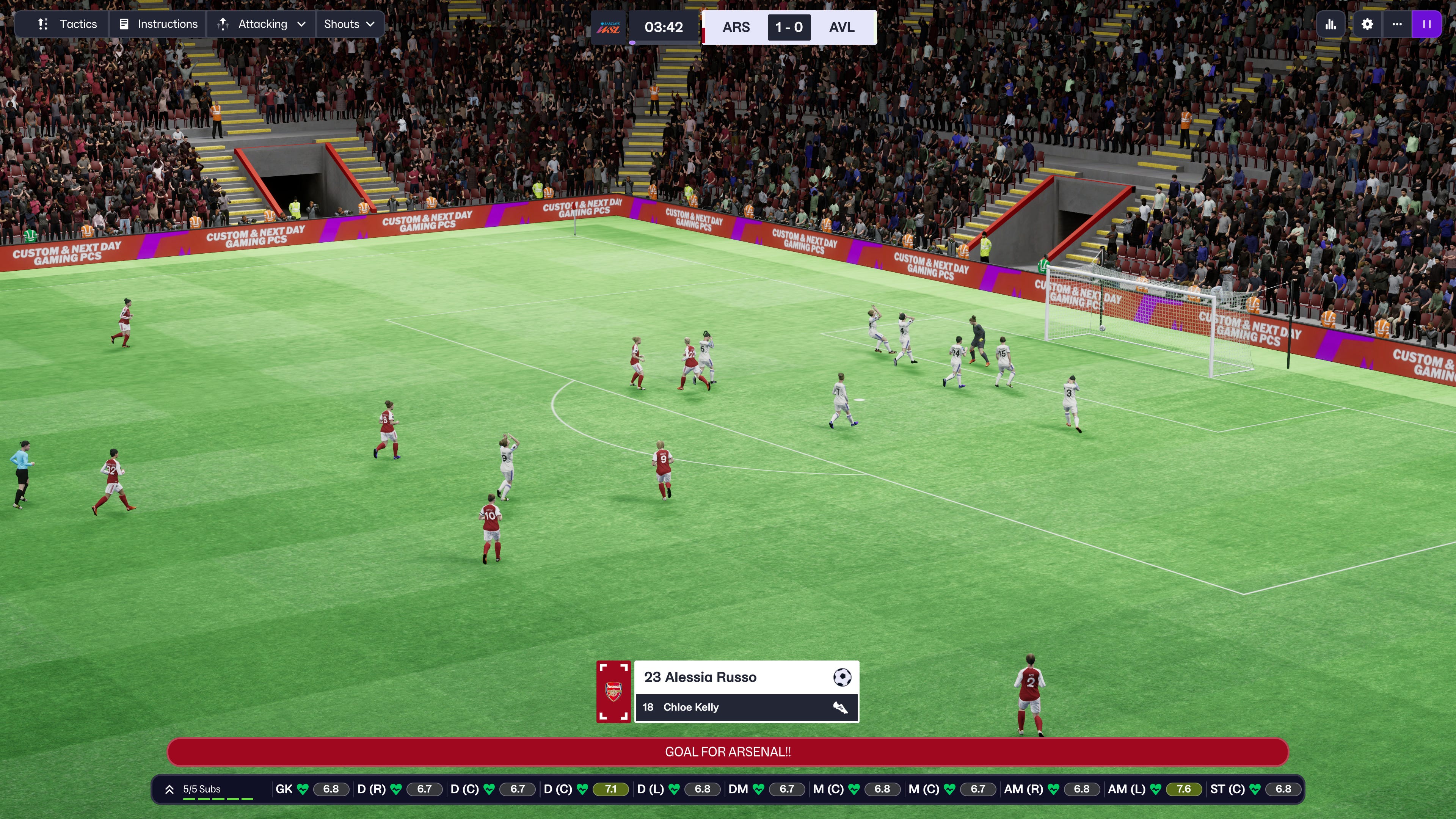
With three wins, 15 goals scored, and none conceded in the opening three games, any imposter syndrome my virtual alter-ego may have been suffering had been washed away in no time. Next up was a home game against Aston Villa as my side looked to maintain their perfect start to the season. A tactical feature of the early weeks of Radwan-ball has been the attacking emphasis placed on central midfielders, and this game was the clearest example of this yet. Off the back of scoring from the bench, I rewarded Pelova with a start, picking her ahead of Kim Little on the right side of the double pivot in an otherwise unchanged XI.
My faith in her was rewarded, as the Dutchwoman was one again on the scoresheet – one of four players to find the net in the first half as my team raced into a 4-0 half-time lead for the second consecutive home match. The surprise goalscorer on this occasion was Lotte Wubben-Moy, who would, astonishingly end the match with 3 goal contributions (1 goal and 2 assists). My free-scoring Arsenal side would notch another 3 goals in the second half as part of an eventual 7-2 victory.
In real life, this was the fixture in which Slegers’ side failed to score at least 4 goals at home in the WSL for the first time. In the FM-verse, it is now 4,5,6 and 7 goals scored in Arsenal’s opening four games. The only blemish on the day was an end to a flawless defensive run to start the season, with Villa netting 2 second-half consolations. A sign of problems to come, perhaps?
Once again, I had the best part of a week to prepare for a Friday night showdown with Manchester City at the Joie Stadium. On paper, this would have been my toughest test of the season yet, but City had enjoyed a nightmarish start to the season, sitting second-bottom having failed to win any of their opening four games, in a winless run that included a 7-2 defeat at home to Brighton.
In my pre-match briefing with assistant head coach Aaron D’Antino, I made sure to focus on opposition analysis, instructing my players to tightly mark Lauren Hemp and Bunny Shaw. However, I ignored advice to play with a lower defensive line of engagement, wanting to stick with the principles that had got my team off to such a flying start. Would this be a tactical masterstroke or a show of naivety from an inexperienced manager? Only time would tell.
With that said, I did make a couple of tweaks to my line-up in an attempt to play a more controlled brand of football. Firstly, I reinstated Little to the midfield, dropping her slightly deeper out of possession as I had done previously against United. I also changed Katie McCabe’s role for this one to playmaking wing-back, which instructs the player to step into the midfield. Finally I instructed my team to play with a lower tempo than usual to avoid turning the ball over.
Having dominated every match prior to this, it was clear that my Arsenal side were in for a game this time out, with City showing no signs of being a team that started the weekend second bottom of the table. Having taken the lead through Alessia Russo, my team were quickly pegged back after Wubben-Moy diverted into her own net. Going into the break level at 1-1, I decided to revert to a more attacking style in the second half, instructing my team to up their passing intensity, and replacing Little with more attack-minded Pelova.
Reverting to the chaotic style of football that had produced outstanding results in the early weeks of the season, this match proved to be a case of flying too close to the sun, as City exploited gaps in my press-oriented setup in a dominant second-half performance. Two goals inside the first six minutes, one of which was scored by Vivienne Miedema, put City firmly in the driving seat. Caitlin Foord pulled a goal back on the hour, but any hope of a comeback was short-lived as Alex Greenwood scored a fourth, from the penalty spot, just two minutes later, and that was that.
This abrupt end to a flawless start to the season served as a sharp reminder that Football Manager has a way of humbling you when you least expect it, a feeling that seasoned players of the game will be all too familiar with.
Having to rouse my players after a defeat for the very first time, I will no doubt learn more about my team in the games to come – with the return of Champions League football and a showdown against the old enemy, Chelsea, looming on the horizon. Tune into part three to see how my side fares in matches which could shape the direction of my save.
This is paid partnership with The Cutback and Football Manager.


