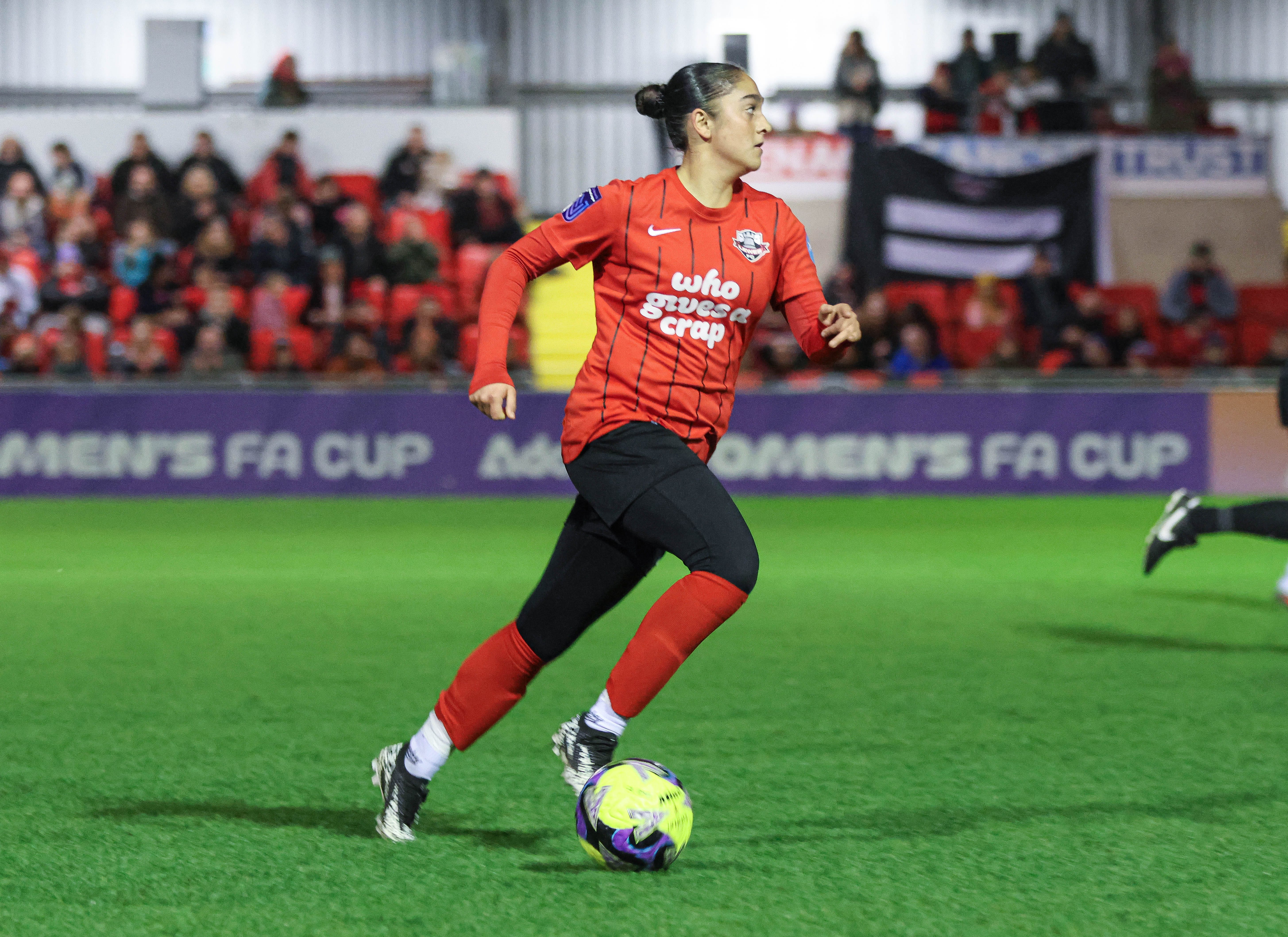
Layla Banaras is redefining what representation looks like in football
The Lewes midfielder on playing for Pakistan, observing Ramadan as an elite athlete, and being a Brown Girl Sport ambassador
Twenty-year-old Layla Banaras is one of the few South Asian women playing professional football in the UK, and she is part of the generation reshaping the landscape of the sport.
After being scouted by Birmingham City at a young age, she spent 11 years in the academy system, joined Wolverhampton Wanderers on dual registration in 2024, and signed her first professional contract at Lewes in August 2025.
With a Pakistani father and a white British mother, she has always felt a strong connection to both sides of her heritage. That identity became even more meaningful when she made her international debut in the Asian Cup qualifiers last summer: “I can represent both Pakistan and England so I think I can represent both just as much as I can represent the other. I represented Pakistan in the summer just gone for the first time which was an amazing feeling.”
“I met so many amazing people and I felt so proud putting on the shirt and singing the national anthem. It shows you why it’s more than just football sometimes. My dad flew all the way out to Indonesia, and I saw him in the crowd with his Pakistan flag. All my family were watching at home. It’s crazy to think that I was representing a nation of 250 million people.”
For several reasons, the Pakistan women’s team did not play a single match between 2014 and 2022, so coming second in the group exceeded expectations and they are currently ranked 154th in the world.
For Banaras, the experience showed how much potential the team has. “Consistency is key,” she believes. “We had a two-week camp before the qualifiers and we came second. It goes to show that the more time we spend with each other, the better we can be.”
The next step for Pakistan will come in April, their first time playing in the FIFA Series. Results on the pitch are only part of the wider challenge of Pakistan women’s football. Investment, infrastructure and exposure remain major barriers, but Banaras believes that the Pakistan Football Federation is taking the necessary steps to change that.
“The new PFF president [Syed Mohsen Gilani] is really working on getting the leagues, refs, and organisation in place to make it accessible for everyone to play football. Hopefully over the next few years, that will change, and it will be really great to see the talent coming through.”
A social media post from the PFF in July 2025 announced plans to establish dedicated departments for women’s football development with the support of FIFA. There are also initiatives for a professional league to be introduced, projects to construct modern pitches across the country, and to implement the sport in schools.
They may not have qualified for the Asian Cup finals, currently taking place in Australia, but the team’s campaign resonated with fans.
“After the tournament, receiving so many messages showed the impact we had,” Banaras reflects. “People I will never ever meet were watching the games and feeling inspired. Knowing that there are more eyes on international football was nerve-wracking at first. But to be honest, it really has just pushed me to keep going and to show the world that Pakistani women can play football. We can compete with these top teams like we did in the Asian Cup qualifiers.”
As a Muslim athlete, visibility extends beyond nationality to faith. She has always been conscious of the limited understanding of how her faith intersects with elite sport, for example during the holy month of Ramadan, where those observing avoid food and drink from sunrise until sunset. At the age of 12, she worked with Birmingham City’s nutritionist to design a Ramadan-specific meal and hydration plan. It has since expanded to the ‘Ramadan Nutritional Guide and Planner’, a resource that other Muslim players observing the fast can use.
More recently, she has begun documenting her Ramadan routine on social media, sharing ‘day in the life’ videos of her balancing fasting with training and matchdays. It has brought up questions from online followers and those around her, but she enjoys using her platform to educate others. “Coming to a new club this season, I’ve had to re-explain things to my teammates and coaches about Ramadan, and some people have asked about why I wear leggings,” she says. “It’s nice to know that people have an interest and actually care. I’d rather people ask questions than keep it in. No question is a bad question.”
This current Ramadan period has led to increasingly visible conversations in football. The French Football Federation does not allow matches to be paused in order for players to observe iftar (the evening meal that marks the end of the fast) if it takes place during a match. Therefore, during a recent men’s Ligue 1 match, a goalkeeper pretended to be injured so his Muslim teammates could quickly break their fast and drink water. Similarly, a Premier League match at Leeds United paused for players to break their fast, and the pause was met with audible boos and contempt from the crowd.
Banaras has followed those discussions but has only had positive experiences herself: “I’ve had to break my fast twice during night games when I was at Wolves. We spoke to the ref beforehand, and he said he was happy to stop the game which was really nice. Everyone stopped and it was amazing that everyone respected that. I know that’s not the case in every scenario like a keeper having to go down and pretend to be injured. I think football should be inclusive and accessible to everyone in the game but in my experiences, I have had really positive outcomes which some people don’t have.”
Her passion for representation has led her to become an ambassador for Brown Girl Sport, an online platform aimed at amplifying South Asian female voices in sport. Founded by journalist and presenter Miriam Walker-Khan, the community brings together women of all ages and nationalities to feel a sense of belonging and share the love of sport. Run entirely by volunteers with no funding, it just celebrated its third anniversary with an event hosted by Chelsea Football Club, which Banaras was proud to be a part of.
“For me, representation is so critical for young girls,” she contends. “If you can’t see something, you can’t be it. When I was younger, I was watching football and thinking ‘there isn’t anyone professional that is Muslim or South Asian so is it even possible?’ But it actually pushed me even more because I wanted to be that person for these young girls, to show that they can do it because that’s what I didn’t have.”
Research from Sky Sports found that while 11.4% of grassroots footballers in the UK are South Asian women, representation at the elite level remains extremely limited. Among roughly 37,000 male professional players in the UK, 22 were of South Asian heritage. Brown Girl Sport focuses on highlighting these stories and challenging the traditional stereotype that South Asians do not exist or succeed in sport. In doing so, it inspires younger generations especially to pursue their dreams and increase overall participation levels in sport.
BGS has also partnered with Chelsea to launch a new Supporters Club for Women of Colour, the first of its kind in women’s football.
For Banaras, the goal is not simply to be counted as one of the few.
“I hope one day there isn’t even a question about whether you can be South Asian and play football,” she states. “I want the representation barrier to disappear. In both Pakistan and the UK, I want young girls to have access to football – pitches, clubs and real opportunities. There needs to be accessibility within communities so that girls can actually play.”


