


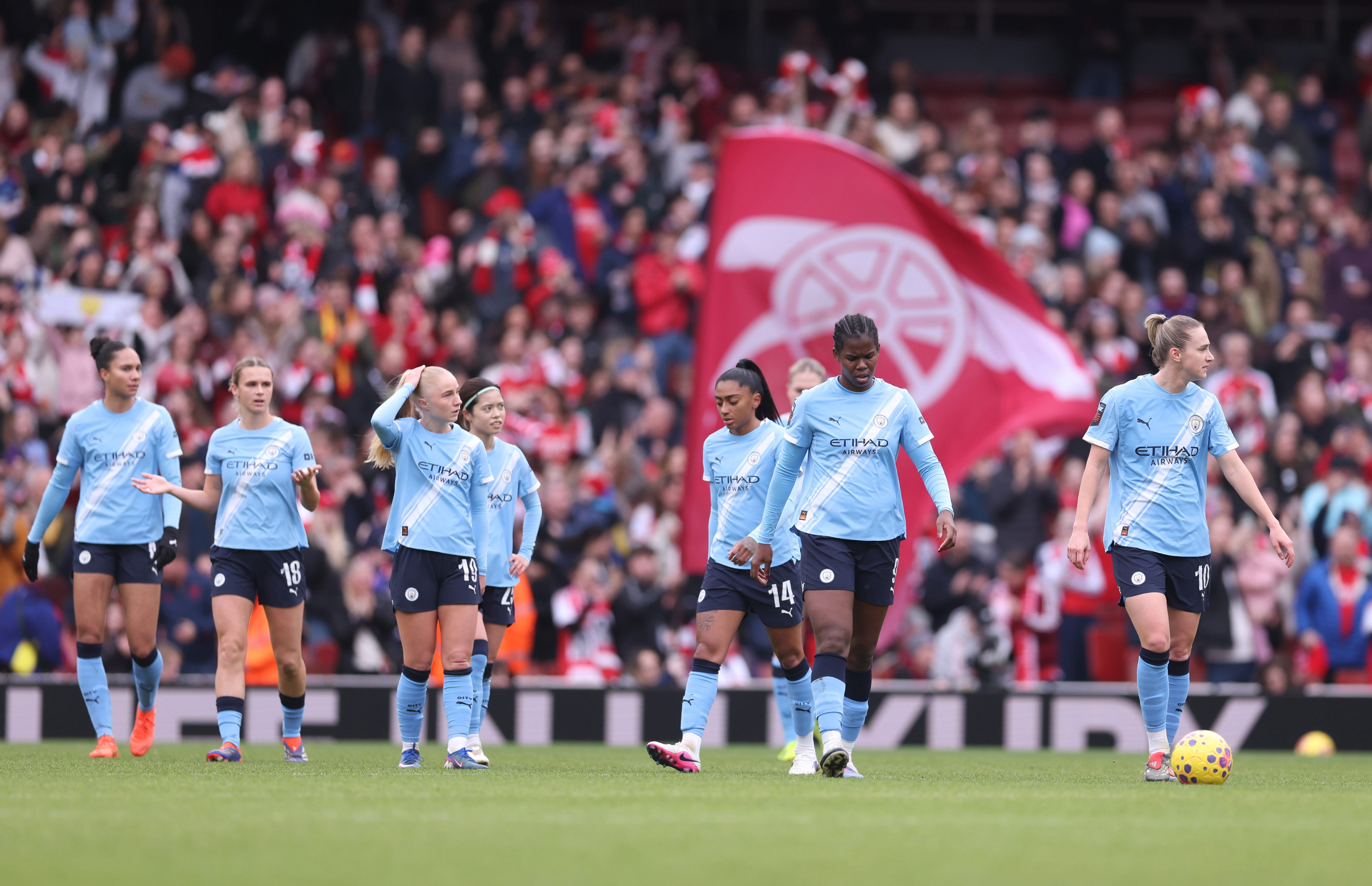
Manchester City arrived at this game on the back of a statement 5-1 win over rivals Chelsea, while Arsenal, still with a game in hand, needed a result to propel them into the Champions League places. After Stina Blackstenius took a last-minute knock, Renée Slegers opted not to restore Alessia Russo as a traditional No.9. The gaffer doubled down on the pacey striker solution instead, deploying Olivia Smith centrally with Russo operating from the 10 zone.
The choice made sense in context, and on paper, both teams had the tools to deal with the opponent and put pressure on them. In practice, the game unfolded in a less balanced way.
A well-orchestrated plan
Arsenal’s attacking structure revolved around the use of Smith as a false nine, a choice that served multiple purposes against a City defence used to man-oriented references. Smith frequently dropped off the frontline, dragging a centre-back with her and opening central lanes for late arrivals, most notably Russo attacking the centre of the box from the No.10 position, as well as wide players like Beth Mead and Caitlin Foord cutting inside. The absence of a fixed reference point consistently forced City’s back line to make uncomfortable decisions, stretching distances and disrupting their usual defensive timings.
At the same time, Smith’s profile allowed Arsenal to threaten depth far more than a traditional false nine would. Beyond her movements towards the ball, she repeatedly attacked the space behind City’s high line both in transition and in settled possession. This dual threat was key to the opening goal in the 17th minute. Out of possession, Manchester City looked to shield Arsenal’s central progression with their resting shape and one of their pivots closing down Arsenal’s. A moment of carelessness in this phase allowed Mariona Caldentey to play a one-two with Kim Little, effectively bypassing the first two lines of City's pressure and playing a perfectly weighted vertical pass into depth.
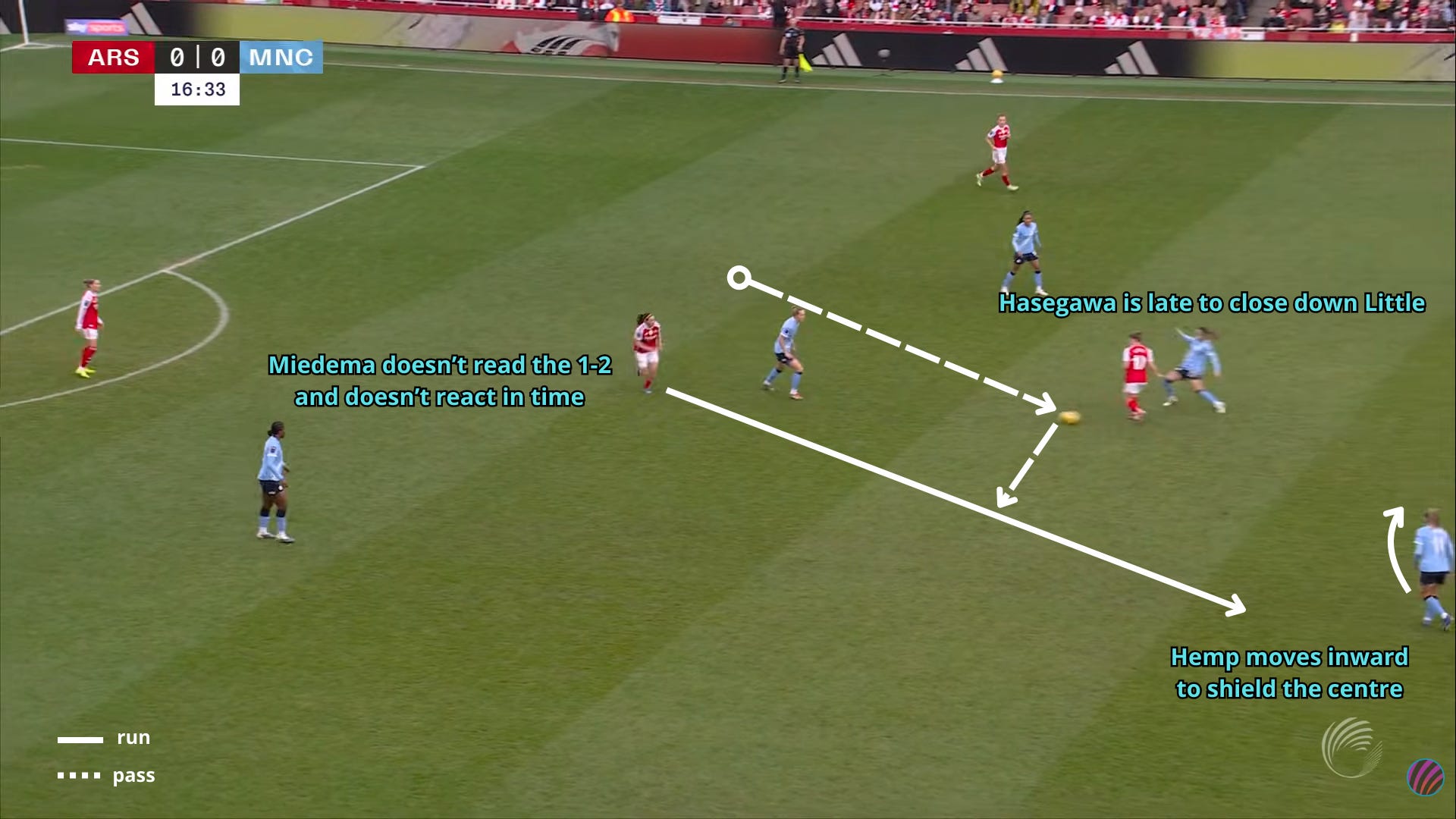
With City’s centre-backs positioned too far apart, Smith could isolate Rebecca Knaak (the slower of the two), while Jade Rose was too distant to provide cover, allowing the forward to attack the channel and finish the decisive action. It is worth noting how both Yui Hasegawa and, especially, Lauren Hemp still chose to follow the gameplan once the pressure had been broken. They shielded the middle rather than aggressively going for the duel on the ball-carrier or, at worst, resetting play with a foul. Neither recognised the danger of a potential ball in behind, probably because they had no way of knowing how disjointed their backline was in that instance. It showed the risks of a system that requires perfection, but also how much this City squad has already bought into Andrée Jeglertz's principles.

