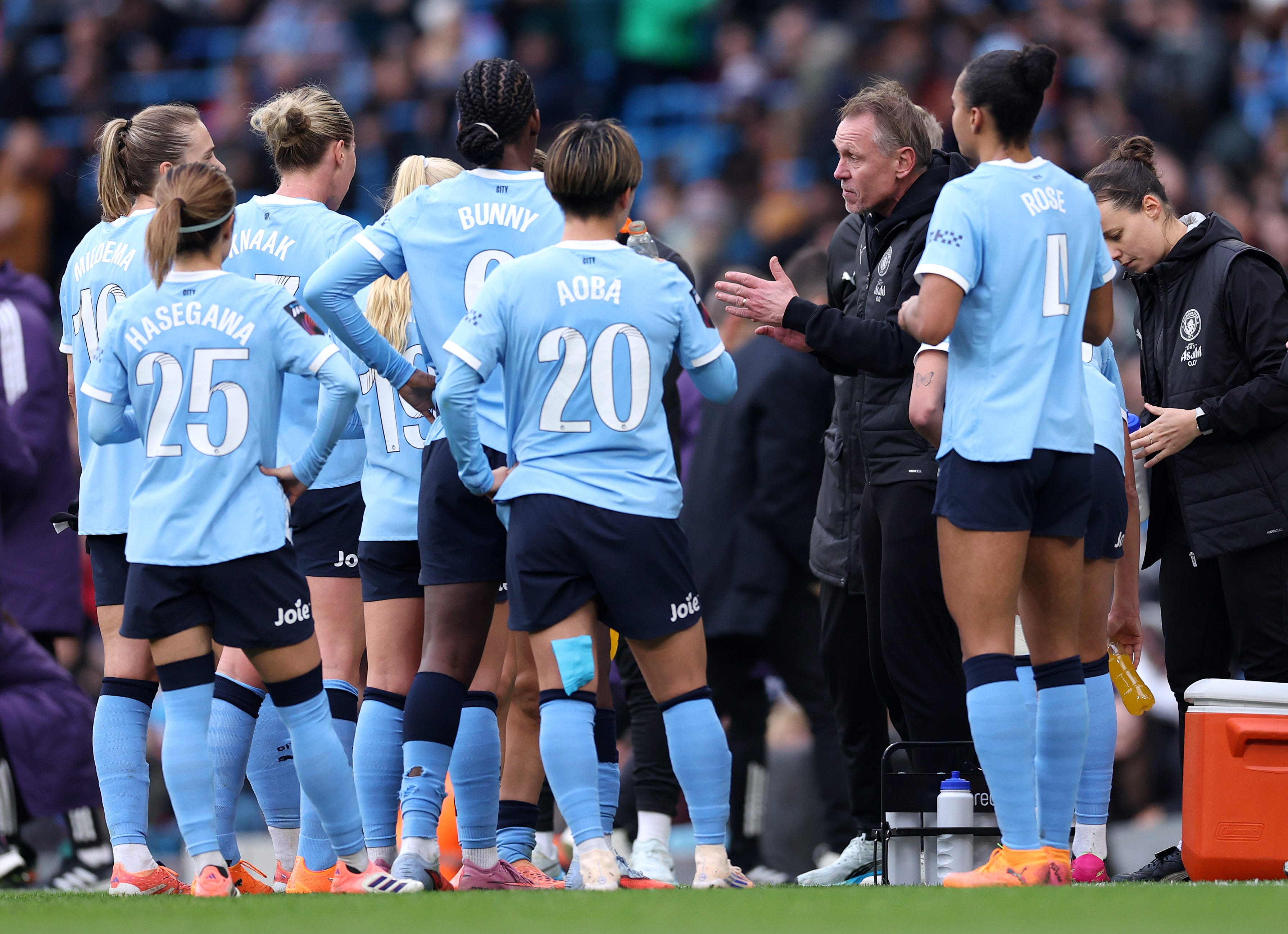
Andrée Jeglertz's Manchester City: Formation, style of play and key players
Tactical deep dives on all 12 Barclays Women's Super League sides from The Cutback and Football Manager
The Cutback has partnered with Football Manager to deliver a series of articles that go deeper on the tactics and gameplay of the world’s leading football management simulation game ahead of Football Manager 26’s release.
This year, women’s football features in Football Manager for the very first time, so to get fans ready for a brand new experience, The Cutback has put together the ultimate insights on FM26. Find out about the secrets of building FM26, dive into the tactical details of all 12 Barclays Women’s Super League sides and hear about the next gen talent that will feature in the game.
The next team to be profiled in this deep dives series is Manchester City.
Formation
Under new head coach Andrée Jeglertz, City have begun to reshape their identity. The former Danish national boss has moved the side away from Taylor’s long-standing 4-3-3 into a more structured 4-2-3-1. In midfield we can find a double pivot of Yui Hasegawa, deployed as a deep-lying playmaker and orchestrating circulation, and Sydney Lohmann or Laura Blindkilde, whose roles are more elastic. At times they drop in to support the build-up, giving Hasegawa freedom to step higher; at others they press aggressively and act more as box-to-box midfielders. Across it all, they mix defensive duels with reliable distribution, offering both quality and quantity in midfield. Ahead of them, there is an attacking midfielder, tasked with offering creativity, good finishing and relentless pressing, players like Vivianne Miedema and new addition Grace Clinton can fill that spot.
On the right flank, an inside forward like Aoba Fujino is used, positioned closer to Shaw than usual and encouraged to cut inside onto their stronger foot, while on the left they have a player starting wider, with both the ability to invert or maintain width like Lauren Hemp or Kerolin. The full-backs advance with discretion: on the right there have been more overlaps due to the narrow winger role, while on the left, attacking runs are more measured. Khadija Shaw remains the spearhead as a channel forward, the side’s main goal threat and physical reference point. Her ability to hold the ball and link play makes her the natural focal point of the team. As City head into the winter break top of the WSL, the framework suggests a more balanced and role-driven structure than in previous seasons.
In possession: City’s attacking structure has evolved with Jeglertz’s arrival. Whereas Taylor’s side often leaned on Hasegawa alone to dictate, even too isolated at times, the new double pivot shares responsibilities: Lohmann drops deeper to provide defensive cover and progression, allowing Hasegawa to step forward and connect. This creates a more stable base and shortens distances between the lines.
In possession the approach is quicker and more vertical than in past seasons. The ball is still circulated with patience, but the goal is to break lines decisively and faster than before. The advanced playmaker is crucial here, as they need to offer a consistent outlet between midfield and attack, linking combinations with Hemp and Shaw. Having a very narrow right winger means they can drive inside onto their stronger foot, attacking half-spaces and combining short. The downside is reduced natural width on that flank, as seen in the opener against Chelsea, where City sometimes lacked release options out wide.
City’s progression is channelled primarily through central routes. From the double pivot, either Hasegawa or Lohmann stretches forward to receive between the lines, while higher up the attacking midfielder and inside forward position themselves in pockets to link play and create forward lanes. The intention is direct: to find players on the half-turn who can accelerate attacks immediately. Rather than long spells of sterile possession, Jeglertz’s side look to connect quickly through the spine, combining short patterns with vertical passes into the advanced midfielders or directly to the striker. Early crosses and diagonal balls from the fullbacks directed behind the opposition’s defensive line are used frequently and effectively, as City has a lot of pace up top, both in their striker options (Shaw or Fowler) and on the wings (Hemp, Fujino, Kerolin and Beney), which makes the side particularly dangerous against high lines.
Out of possession: Jeglertz has clearly shifted City’s defensive identity towards a gegenpressing model with player-to-player marking and tracking references across the whole pitch. The team now defends in a very mobile 4-4-2, with wingers starting a bit narrow and Miedema pressing in line with Shaw. But now, the goal is no longer to simply hold shape and recycle possession as in the past, but to react aggressively in every phase: shield and suffocate central areas; as the ball is in play and naturally directed towards the wings, aggressively close down opponents and win the ball high; and then immediately launch attacks from regained possession.
This more dynamic and proactive style was evident against Chelsea and Arsenal, where the press was intense and City sought to trap opponents as soon as they tried to build. Timing and cohesion are still being refined, there were moments where the press was broken and large spaces appeared down the flanks. In the second half of the Chelsea match, leaning even more towards direct marking references, even having the centre-backs deep inside the opposition’s own half if needed, helped tighten distances and showed how effective this system can be when the team remains compact and precise in its timing. The intent marks a clear break from the control-possession ethos of previous years, and the gegenpress with consistent pressing and counter-pressing has become an important pillar of the new system, and so far it has been the main source of chance creation.
Key players:
Khadija Shaw – As one of the best centre-forwards in the world, Shaw combines physical dominance with intelligence, able to receive under pressure and link play, to provide ruthless finishing and to directly run at defences. Her presence forces defences to drop deeper, creating room for her supporting cast to exploit. Shaw’s consistency in front of goal makes her indispensable, and under Jeglertz, she remains the focal point of the team and a leader in the WSL golden boot race.
Yui Hasegawa – The heartbeat of City’s midfield, Hasegawa thrives in every system. Technically secure, she controls tempo with short and long distribution, while also stepping higher to connect with the attackers, and in her new role under Jeglertz, even to box crash. Her vision and calmness under pressure ensure City can maintain possession even under aggressive pressing. Already one of the league’s best midfielders, her ability to dictate and adjust makes her vital to City’s balance in every phase.
Lauren Hemp – Hemp’s ability and willingness to play on both flanks have reshaped City’s attacking dynamic. From the right, she can cut inside onto her left and destabilise defences with acceleration and close control. But she remains equally capable of stretching play and creating chances with her sharp crossing, always keeping opponents guessing, especially when deployed on the left. Her dribbling threat in half-spaces is set to become central to City’s attack, and if she can refine her final ball from inverted runs, she will become even more decisive. Her versatility and work rate also make her crucial in pressing phases and negative transitions, tracking back as a ‘selfless superstar’.
This is a paid partnership with Football Manager and The Cutback.


