


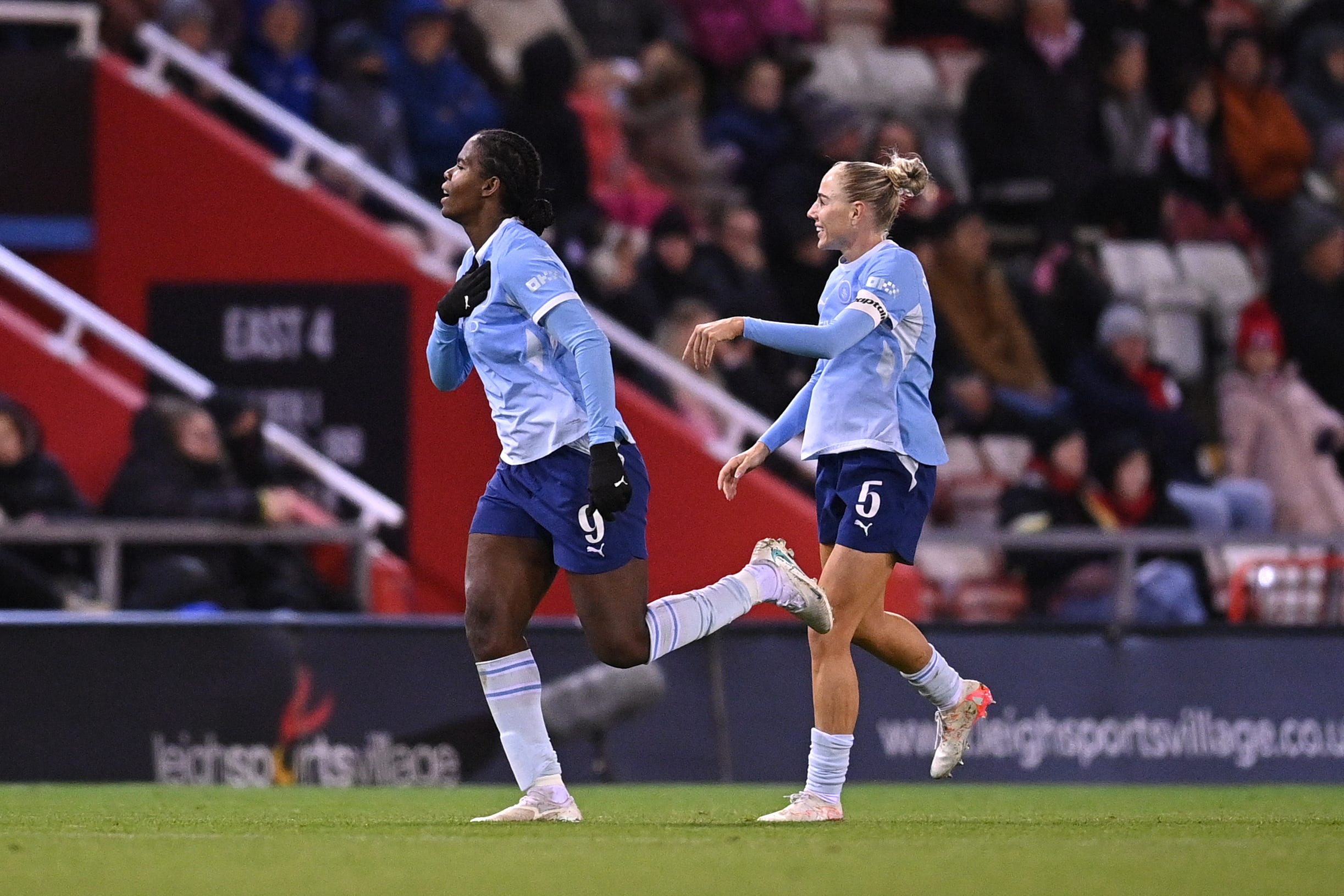
Sunday night’s Manchester Derby had everything: late equalisers, controversial refereeing decisions, players being booed, goal-line clearances and defensive mistakes.
It served plenty of drama and physicality, but the game broadly lacked attacking quality and won’t be remembered with the same fondness as the two derbies last season, in which City blew United away; or the season before last when Ella Toone’s hat-trick at the Etihad sunk an ailing Manchester City side.
City came into this derby as favourites despite United’s recent uptick in form, but they didn’t play like it for most of this match and failed to make their early dominance count. United defended well as City struggled to find openings and, when they did, the end product was often of low quality – Bunny Shaw’s brilliant opener aside.
It’s the first time this season the WSL champions have dropped points this season, but their performances this season have been far from perfect. Sunday night was the first time City have been made to pay for their defensive weaknesses.
Here are five things to take away from a frantic Manchester derby.
City must start keeping clean sheets
Manchester City have only kept one clean sheet this season in all competitions and that was against WSL minnows Charlton. This hasn’t been a problem in the majority of the games this season, but City’s lack of defensive solidity has come back to bite them against better teams. They are yet to win in the Champions League and this is their third score draw of the season.
The reasons for the defensive frailties are varied but the biggest one by far is individual errors, specifically poor clearances, and that was the reason for the United equaliser. In every WSL game they have conceded at least one goal from a poor clearance, a sloppy pass, or both.
Manager Andrée Jeglertz’s constant rotation in defence has made it harder for City to build relationships and rhythm, especially at full-back. Players are therefore more likely to make mistakes, especially when it comes to communication.
Some of the blame can be laid at the feet of individuals in the defence who are yet to scale the heights they reached last season. But City systematically look to play through the counter-press when they regain the ball in their own third, and that increases the chances of losing the ball in a dangerous area.
Terland’s equaliser came from a set-piece, which is the third time in as many games City have conceded from a dead-ball situation. It was a strength of theirs last season, when they conceded only once, so it is another part of the game they have to fix.
The pros and cons of aggressive full-backs
One tactical tweak from last season was to tone up the aggression of the full-backs. Beney and new signing Carlotta Wamser are probably as attack-minded as you can get in terms of intent, and Beney was selected as an out-and-out winger for this game.
City’s full-backs like to position themselves aggressively to win the ball high up the pitch, and that has reaped rewards going forward. However, it makes City vulnerable on the counter in wide areas and United were able to exploit them throughout this game.
Does Shaw get the fouls she deserves?
At the centre of most of the controversy in the match was City’s talisman Shaw. She managed to wriggle away from Le Tissier before being brought down by the England defender as she bore down on goal. The referee did not think the contact was sufficient to blow for a foul. The threshold for a foul in that situation is likely higher because it would definitely have meant a red card.
Shortly after, Le Tissier barged into Shaw off the ball, and the Jamaican Ballon d’Or contender quickly retaliated with a foul of her own seconds later. The United crowd were not impressed and every subsequent Shaw touch was met by a chorus of boos.
It was the same against Brighton last weekend, when a lot of strong challenges on Shaw went unpunished. It raises the question of whether the threshold for a foul on a player as strong as City’s number 9 is higher than it would be for any other player.
City manager Andrée Jeglertz was asked about it after the derby and said: “She is very strong and sometimes she gets knocks and hits. It takes a lot to make her fall to the ground. Sometimes I feel the level of what they give her is not right.”
City’s lack of pressing intensity
Another reason why United were able to get a foothold in the game was that City’s intensity in the press waned as the first half wore on. They were picking up loose passes in United’s defensive and middle third earlier in the game and their best chance of the half also came from their press and fell to Lauren Hemp.
That largely diminished over the course of the game and it was especially disappointing due to United goalkeeper Phallon Tullis-Joyce’s well-documented issues on the ball. The hosts were able to play through City in the second half and force them back for large parts of the game.
One injury away from crisis?
Manchester City have made the most changes from game to game in the WSL this season. Jeglertz has said it is because he trusts all the players in his squad, allowing him to rotate between them regardless of the level of the opponent. That is one of the reasons why City’s bench is always able to affect the game. Most of the players being subbed on are starter-level quality and already have minutes under their belt.
However, City’s midfield depth is injury prone and it is a key area where Jeglertz cannot rotate. This wasn’t a problem last season, when City had no UWCL football to worry about and Yui Hasegawa and Laura Blindkilde Brown were able to shoulder most of the burden. The arrival of Sam Coffey in January was supposed to help in that regard but she has had her fair share of injury setbacks.
In the United game, City weren’t able to shore up the midfield when they started to lose the midfield battle. The first midfield substitute was Grace Clinton, who started the season on the sidelines due to injury. She did not make much of an impact besides the massive chance she missed late on. The second was Sydney Lohmann, whose last start in the WSL was her debut on the first game of last season.
As it stands, Coffey is out for the time being and Vivianne Miedema will miss most of the first half of the season with a knee issue. City’s fortunes this season may depend on the continued fitness of Hasegawa and Blindkilde Brown, who will have more minutes put into them than most other City players.
