The Kang dilemma: Vital investment, multi-club ownerships - and the warning signs
Women's football's main benefactor continues to wield influence but is it good for the game?

Another day, another headline-grabbing move from Michelle Kang.
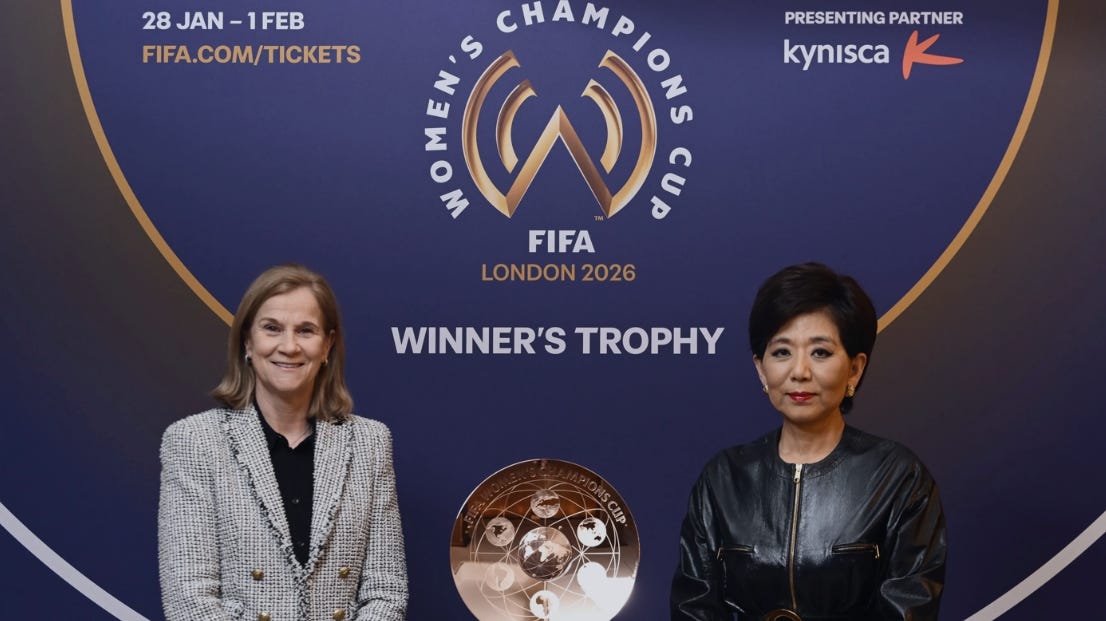
No, this wasn’t the news that Washington Spirit had signed Trinity Rodman to a record-breaking deal. It was that Kynisca, the parent company of Kang’s three women’s football teams, London City Lionesses, Lyon and Washington Spirit, had become the presenting sponsor of the inaugural Fifa Champions Cup.
The new intercontinental club competition is taking place in London next week, and involves Uefa Champions League winners Arsenal, Concacaf Champions League holders Gotham, Morocco’s ASFAR and Brazil’s Corinthians.
Kynisca is certainly not a consumer-facing brand; it’s an investment group. However, this is not the first time we’ve seen Fifa partner with a fund rather than a brand. Last year, Saudi Arabia’s Public Investment Fund became an official partner of the revamped men’s Club World Cup. PIF is the majority owner of Premier League, and WSL2 side, Newcastle United.
What makes the Kynisca deal more eye-catching is the fact that Kang is a leading multi-club owner in the sport, albeit none of her teams are participating in this first edition of the competition.
This partnership is only active for the 2026 edition of the Fifa Champions Cup and it remains to be seen what involvement Kynisca or its clubs would have in future iterations.
Kang herself already carries huge influence in women’s football. She is the deputy chair of Fifa’s women’s club competition committee, alongside several league commissioners and ex-players.
That committee includes Bestine Kazadi, vice-president of the Confederation of African Football (CAF) executive committee, Lamia Bahain, from the Saudi Arabian Football Federation, Jessica Berman, commissioner of the NWSL, as well as several other federation execs.
Kang is the only club owner to sit on that committee.
The billionaire also has a long-term relationship with US Soccer. In 2024, she donated $30 million to the federation, the largest philanthropic gift the organisation had ever received. Last year, the Kynisca Innovation Hub, the organisation’s athlete research arm, was absorbed into US Soccer’s Soccer Forward Foundation. The move also included a $25 million investment from Kang.
Kang was also named as an investor in Just Women’s Sports, the global women’s sport media brand.
Her investments have understandably been welcomed by many in women’s football as the game deals with a chronic resource issue. Kang has talked openly about the commercial value of women’s sport and has not treated it like a charity. But is there a risk of letting one individual have so much power in the women’s game?
What is very clear is that Kang is hugely involved across the entire landscape of women’s football, from club ownership to athlete development to governance and sponsorship.
Multi-club ownership and Fifa’s relationship with entities like PIF has long been a thorn in the side of men’s football. We’ve seen regulations around multi-club ownership in club competitions impact several teams.
Mexico’s Club Leon were not allowed to participate in last year’s men’s Club World Cup as another club in their ownership group, Pachuca, had also qualified for the tournament.
At the start of this season, Crystal Palace were demoted by Uefa to the Conference League as their co-owner, John Textor, held shares in both Palace and Lyon, who had qualified for the Europa League.
We are yet to see regulations around multi-club ownership impact the women’s game but it feels like it’s only a matter of time.
Kynisca is not the only multi-club ownership group in women’s football. In general, there is far more resistance to it with Bay Collective and Crux Football launching in the past year. Angie and Chris Long, owners of the NWSL’s Kansas City Current, also recently purchased Danish side HB Køge.
The qualification criteria for the 2028 Women’s Club World is still to be decided with Uefa receiving five automatic spots in the competition, while AFC, CAF, Concacaf and Conmebol will each have two direct slots.
Given the global spread of Kang’s teams, and the fact that London City Lionesses are still some way off qualifying for the Uefa Women’s Champions League, there is still time for the women’s game to map out its response. The precedent has been set in men’s football and the expectation will be that the same rules are applied.
But will women’s football multi-club ownership be treated differently if the investment is seen as “good for the game”?
Only time will tell.


I don’t know Flo… i think I’m going to enjoy the unicorn that is Kang for a little longer before I start seeing dilemmas. Maybe I’ve just been here too long 😂🙏🏽
I have been wondering about what it means that Kang clearly wants LCL to qualify for the UWCL sooner rather than later (whether that’s realistic or not) given her ownership of Lyon. So nothing right now to stop both teams playing, if they both qualify? If she’s then so enmeshing herself in football’s governing bodies via investments, I dare say she would be using her influence to keep it that way…