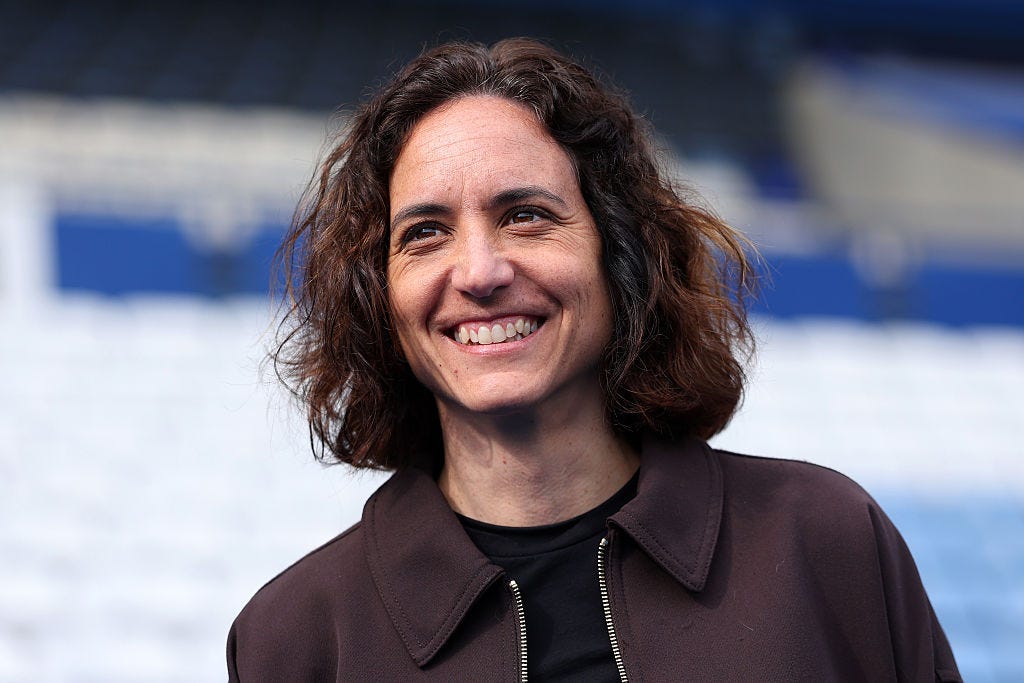
In the world of football, most coaches dread the weekly press conference and post-match interviews. Natalia Arroyo is not that type of coach.
The Aston Villa boss commands a conversation because she has been on the other side of the aisle. She went from player, to part-time journalist and coach, to football manager – an uncommon career path.
Arroyo’s stint as a journalist in Spain came after injury ended her playing career at just 22, but her time in the media has done wonders for her current career. She is excellent with the media – an essential part of football management that very few coaches fully get the hang of. It’s clear that she was a skilled journalist during her time covering games and working as a TV pundit.
I was given a 20-minute slot at Villa’s pre-season media day, and 45 minutes later Arroyo was still chatting, debating her favourite British comedy shows that she watches to better understand the culture in her new home. Mr. Bean and Monty Python are favourites, albeit we joke that most of her squad are too young to know either show.
English and Spanish football are also very different, and much of Arroyo’s time at Villa has been about making adjustments. She arrived in January 2025, replacing Robert de Pauw halfway through the WSL season, and during her 18 months in charge she only managed to win 12 of her 39 WSL matches in charge.
Her Villa career has been inconsistent to say the least. Positive results have been followed up with heavy defeats. Beating Brighton 2-1 one week, before losing 4-1 to United in the following game. Arroyo admits that there is a strong difference between the Spanish coaching environment compared with England.
“Some of our ways of training are different than here. The way we train in Spain is much more ball related and football related. I think that’s a modern methodology anyway.
“Here in England, the players are a little bit less used to small spaces, to rondos where you are not just having fun but thinking about the why in every drill, so every passing drill is not about technique, is about tactical understanding, and I think that’s the challenge.”
The 40-year-old can easily switch into technical coach speak, but it’s clear from how English teams have fared against Barcelona in the Champions League – and when England regularly play Spain at major tournaments and in qualifying – that there is a clash of styles at play. Spain’s possession-heavy style, versus England’s physical and often direct methods.
Arroyo calls the English style “rock and roll” football. And she wants to keep that within her players but also build more connection and confidence between ball and player.
She believes that Villa were undone last season by a lack of depth, and an inability to reliably rotate throughout the season. Villa have signed eight players over the summer, but a key loss has been Kirsty Hanson, last season’s top scorer with 12 goals.
Hanson joined Spurs over the summer, taking a large chunk of Villa’s goals with her. Their next highest goalscorer was veteran forward Rachel Daly with three. Arroyo also lost Ebony Salmon, more of an attacking squad player, and Gabi Nunes, who had struggled since moving to the WSL in 2024.
The Villa head coach isn’t concerned about Hanson’s departure but instead reflects that it was an example of how you can get the best out of a player when you find the right role for them.
“What we can learn from the Kirsty Hanson season is how we were able to to touch the right button with her to make her grow in her goalscoring ability. That was a couple of conversations we had around her role and giving her the confidence and the trust to believe that she could be that.
“She did a great job and if we can repeat the same thing with the other players that we have now, probably we will have the smile at the end of the season, seeing that every single attacking player is so close to the best season ever. Because that was what Kirsty was having, the best season in her career.”
One of Villa’s most impressive recruitments has been midfielder Lucia Kendall, who joined from second-tier Southampton in the summer of 2025. The 22-year-old has been a favourite of Arroyo’s and she was promoted straight into the first team last season, featuring 18 times and getting a call up to Sarina Wiegman’s England squad.
Developing young talent is a particular focus of Arroyo, who worked on Catalonia’s talent pathway in Spain for 10 years during her early coaching years. Arroyo worked with big names that made their way through Barcelona’s La Masia academy including Claudia Pina and Jana Fernandez, who is now at London City Lionesses.
Of the seven outfield players Arroyo has signed this summer, just two are over the age of 23. When she was head coach of Real Sociedad, her side were the youngest team in Liga F and Arroyo is clear that she wants Villa to be a place where young players can thrive.
“If you want minutes, if you want a space to grow. If you want a space to learn, we want to be that.”
Fernandez isn’t the only Spaniard to be reunited with Arroyo in the WSL. London City manager Eder Maestre was her assistant at Real Sociedad for three seasons. Arroyo sees herself as an educator for future coaches coming to the WSL and she’s kept a close relationship with Maestre as they both navigate different demands and ambitions from their clubs.
“I always try to learn from them [other coaches]. I need them to grow, and if I can give them some advice, it’s powerful. I feel I am in the spotlight, if that makes sense. And for some of the younger ones, the ones that are curious, the ones that are starting their career, I try to help students. I try to help them because I was lucky, even as a journalist, trying to learn from senior ones, and I’m really grateful to them at how generous they were at giving me advice. So if I can help them now, I try to be coherent with that and give them that challenge.”
What should Villa fans actually expect this season, given the team lost eight of their final ten matches of the 2025-26 campaign? This forthcoming season is about control, according to Arroyo, but also understanding when to attack games.
“I want to dictate what happens in the game. That’s what makes me more comfortable. That gives me more control, that’s what I want. So I want to be in control, but able to attack. So if control means we are protective, we are scared, we are reactive, no I don’t want that. I want to be proactive. I want to dictate what’s next in possession, out of possession.
“But we also need to realise that in the league, some days we can’t because other teams are better than us or can be better than us in certain areas. So we need to be a little bit adaptable in reading what the game is allowing us to do and be smart, of course.
“One of the things I’m really encouraging the players to do is trust themselves, deal with the storm, deal with the emotions, stay consistent and comfortable in the uncomfortable moments.”
We certainly haven’t seen the best of Arroyo’s Villa and there will be pressure to improve on last season’s poor run. But one thing is clear: if you’re in the coach’s presence this season, grab a microphone and whip out a notebook, because there is so much to learn.


