


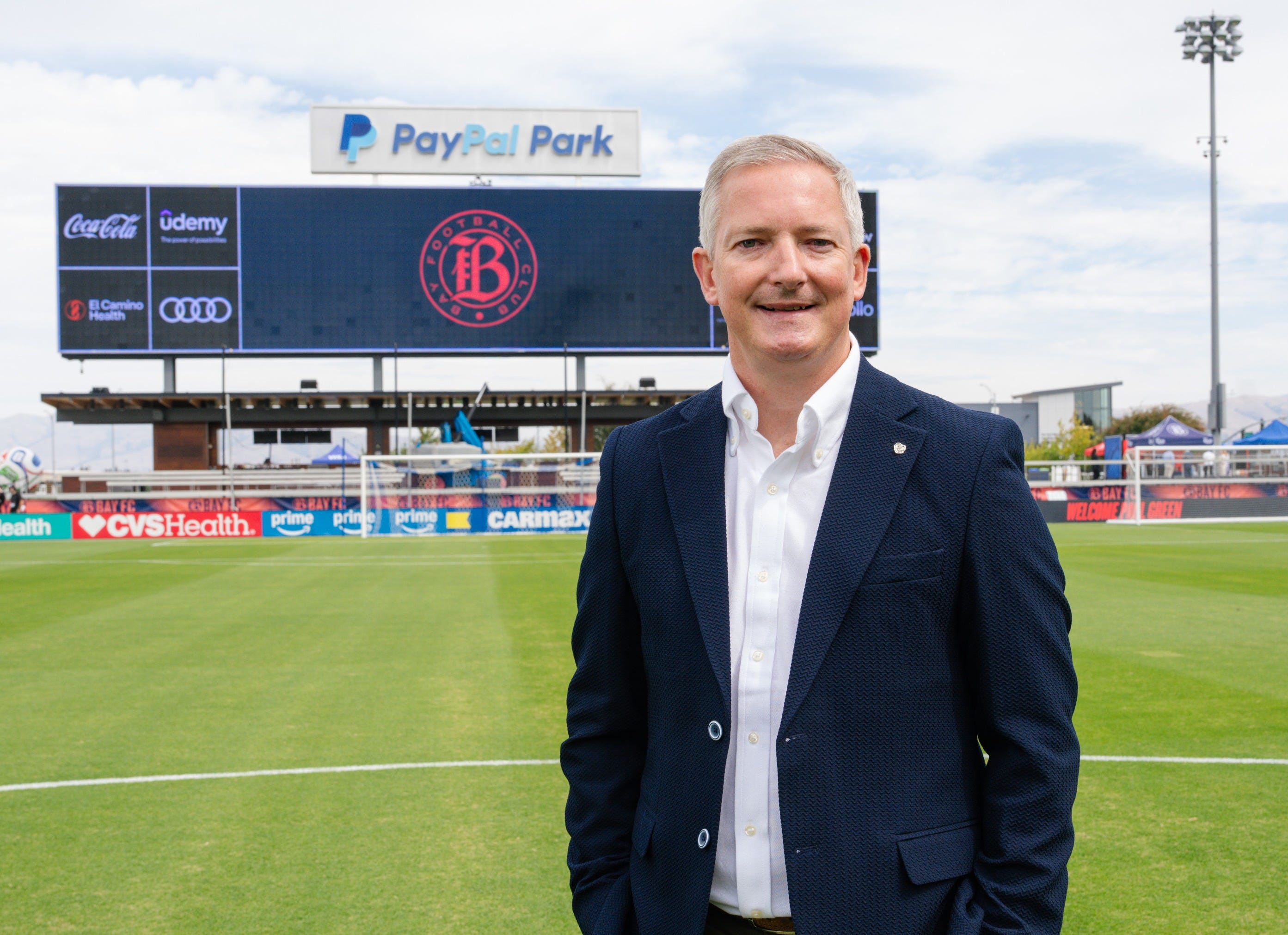
When Paul Green departed Chelsea in February of this year, a fanbase was left in shock.
His exit, two years after beloved head coach Emma Hayes joined the US women’s national team, truly signalled the end of an era.
Green had worked first as Hayes’ right-hand man during an unbelievable period of sustained success, from a first trophy in 2015, to five consecutive WSL titles between 2020 and 2024, and then alongside her successor, Sonia Bompastor. The 2024-25 season saw Chelsea win every single domestic trophy without losing a match. During Green’s tenure the club also reached the Champions League final for the first time.
“It’s a bit weird, I’ll be honest, it brings back a lot of memories”, says Green, speaking at Leaders Week London at Stamford Bridge, a venue he knew very well during his 13-year stint as head of women’s football at Chelsea.
It’s Green’s first return to the club since his exit earlier this year and his appointment as chief football officer at NWSL side Bay FC. Since he left Chelsea, the club has appointed Phil Radley as sporting director, and several of Green’s key signings have also departed, including Millie Bright, who retired, and Sam Kerr and Guro Reiten, who joined NWSL side Gotham.
Green has only been in his new role for about a month and he’s still preparing to make the permanent move to California. The task is clear, take a team that currently sits 14th in the table and turn them into regular playoff contenders. Bay FC haven’t made the playoffs since a seventh-place finish in their inaugural season in 2024. It’s that challenge that drew him to the role in the first place.
“The project, the timing, testing myself in a different league. Trying to replicate the success I had in England in a salary cap league is a challenge, but I’m really ambitious to try and do that, and I think I’ve got the experience to help take them to the next level.
“From speaking with people within the project, [I] really feel that trust on both sides of wanting to get to the next level and felt that ambition from the ownership. With Kay [Cossington], who I’ve known for a long period of time when she worked at the FA, the timing aligned, moving to a new training ground which is a world-class facility built for female athletes.”
This summer, there’s been a number of young English players that have made the move to the NWSL, either leaving WSL sides or moving from Europe to the league, in the case of teenage sensation Erica Meg Parkinson. Green can see the attraction of the NWSL for young players who are searching for game time and senior first-team minutes.
“I think it’s probably beneficial for their development because if you look at the Lionesses squad now and over the last couple of years, all of those individuals were probably playing first team football at 16, 17 in the top league”, he says.
“Those individuals at the same ages now are just not getting those opportunities because of how the WSL has developed, and a lot more foreign talent is in the league. So they do need to get that pathway to develop. I think there has been some top youngsters that have decided to go to the NWSL to try and get that exposure or other clubs have tried to do it in a slightly different way.”
Lexi Potter is a player who has thrived this season for Chelsea, starting three of their five WSL games. Potter spent time on loan at Crystal Palace before making the step up into Chelsea’s starting XI and she could make her debut in England’s World Cup qualifier games against Greece on Friday and Tuesday. Green reflects on the 20-year-old’s quality and why it was so crucial Chelsea kept her.
“She’s a fantastic talent”, he says, “we’ve known all along that she was going to be a top player, we always believed she would make it at Chelsea. I’m not surprised by what she’s doing this season. If I’m being honest, I felt she should have been playing last season. I’m not surprised and really delighted on how she’s performing at the moment. I’m sure she’ll be an England regular for many years to come.”
Speaking to the media ahead of England’s qualifying games, Potter herself echoed those comments, saying: “We [Potter and Sonia Bompastor] had a few conversations over the summer and I made it clear I want to be playing as much as I can this season. Last season, I didn’t get as many opportunities as I probably would have liked, but I didn’t at all expect to play as much as I have so far.”
When Green was at Chelsea, he witnessed first-hand the transformation of the women’s football transfer market, and by the time he left the club, Chelsea were some of the biggest spenders in Europe.
“When I first started at Chelsea, a lot of players didn’t even have agents”, he says “so a long time ago it was a lot easier to get deals done because it would just be me and the player and it would come to an agreement quite quickly normally. But now there are multiple layers to get a deal done.
“The values of salaries, of transfer fees, have obviously gone through the roof compared to when I was first at Chelsea when [it was] mostly just free transfer trading. It’s evolved so much in those 13 years. That’s something that we’ll need to be tackling head on and getting the right balance”.
Green also acknowledges the freedom that comes from working with a team that is unattached to any men’s side.
“If you’re a standalone club it’s unique and I think sometimes you don’t have to go through the layers of bureaucracy to get quick decisions that sometimes at big clubs can be a challenge. It’s a positive that we can build a club in our own right. The business side of the club is doing really well and the fanbase we’ve got, regularly 12, 13, 14,000 even when the team’s not doing that well.”