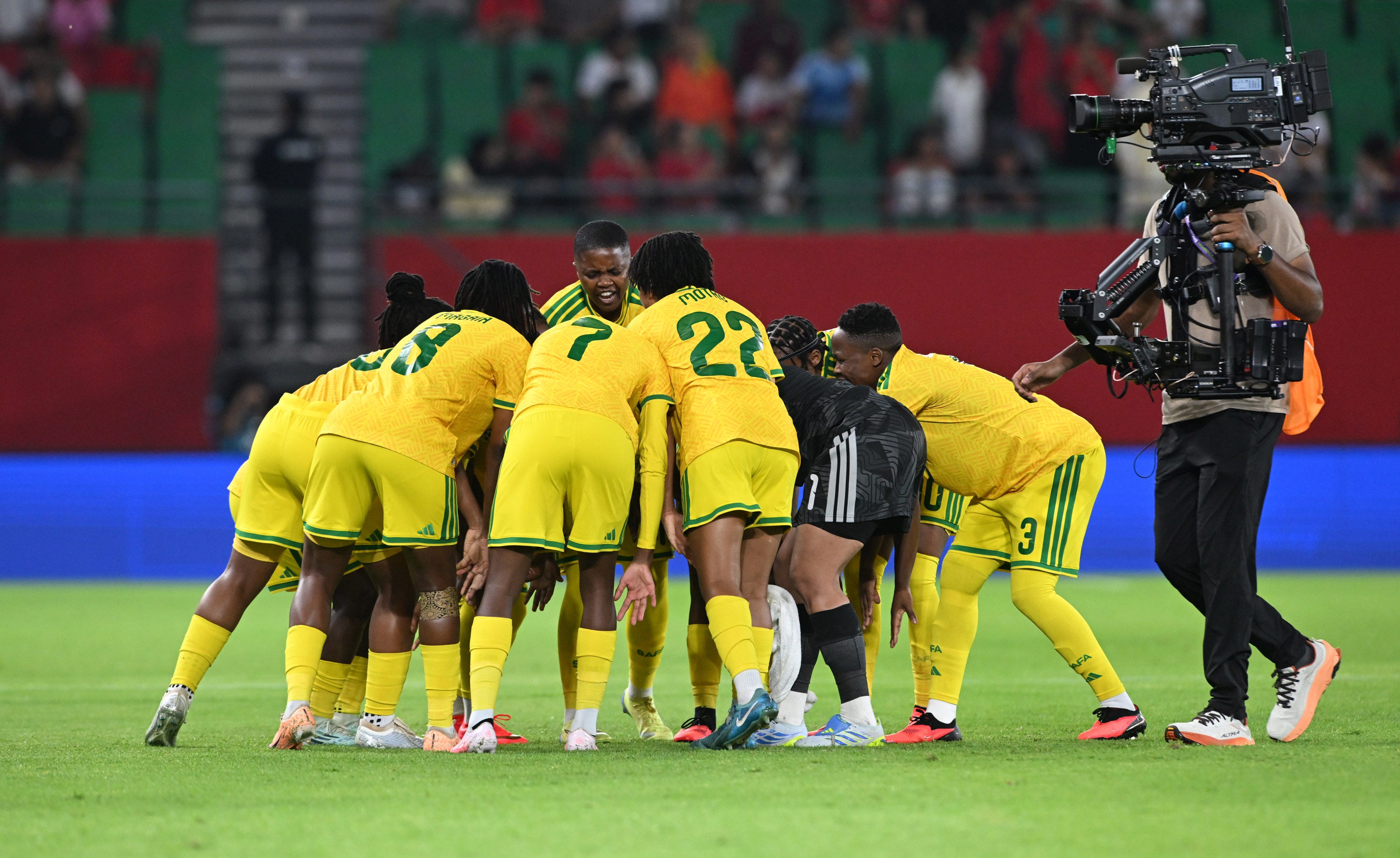
Analysis: How South Africa’s WAFCON campaign came crashing down in the quarters
South Africa endured their worst WAFCON campaign since 2004, falling short of expectations and missing out on a direct berth to the 2027 World Cup.

South Africa were the first victims of what is proving to be a WAFCON 2026 for the underdogs.
Banyana Banyana never truly recovered from their shock 2-1 defeat to Tanzania in their tournament opener, following it up with a dramatic fightback from two goals down against Côte d’Ivoire. While they remained in contention mathematically, they were left at the bottom of their group with only one point after two games, and no chance of finishing first.
A win over Burkina Faso just about took South Africa through to the knockouts, but they couldn’t avoid a matchup against Group A winners Morocco. Going in as underdogs, Banyana Banyana were beaten 2-1, despite putting together their best performance of the campaign. The result ended a streak of nine consecutive WAFCON semi-final appearances.
An ageing squad, tactical rigidity and a lack of federation support all played a part in South Africa’s early exit.
Few fresh faces
With an average age of just over 27 at the start of the tournament, South Africa submitted the second-oldest squad list for WAFCON 2026. Weighted by minutes played at the competition, theirs is the oldest team at an average age of 29.6 years.
While the selection included 10 new names when compared to the 2022 edition, none of them started the opener against Tanzania. In fact, as many as eight starters from the 2022 final took to the field during this tournament, with two of that squad having retired.
Contrast this to the approach of a side like Morocco, and it becomes clear how Banyana Banyana are lagging behind. The Atlas Lionesses had the oldest squad at this WAFCON but have been proactive in bringing fresh faces into the squad. They have made the last two WAFCON finals, all while preserving a consistent core that continues to perform at the top level and, most notably of all, benched legendary attacker Ghizlane Chebbak for teenage starlet Kautar Azraf in their first two games.
Even if the youngster provides no further contribution in this tournament, she will take away valuable experience and be well prepared to step in when a bigger role in the side presents itself.
The lack of turnover in South Africa’s squad isn’t just down to Desiree Ellis’ selection decisions. Her choices were limited given the lack of top talent coming through the youth levels. The under-17 side has not appeared at a World Cup since 2018, and hasn’t even managed to reach the final round of qualification in recent years. To make things worse, they were beaten on their own patch in the 2024 COSAFA U-17 Championship, losing to Madagascar in the group stage.
Lack of off-field support
Poor results and a stale squad are symptoms of deeper issues. The root cause lies with the South African Football Association (SAFA)’s management and support of both the senior team as well as general football infrastructure in the country.
These problems are not new. Banyana Banyana’s WAFCON 2022 triumph was achieved in spite of their federation, before the lack of support was laid bare in the lead-up to the 2023 Women’s World Cup, when the squad went on strike over unfulfilled payments from SAFA. The matter was only resolved when the Motsepe Foundation — linked to South African billionaire and current CAF President Patrice Motsepe — stepped in with a “humble donation”.
That was just one of a long list of issues that star forward Jermaine Seoposenwe explored in a conversation with local radio channel 947 Joburg following her retirement last year.
She said: “Every time we go to a major tournament, we have to fight about money – we have to fight about basically everything. And it’s like why do we have to fight? Why can’t you plan out for the year?”
Amid these circumstances, it should be easy to see why Banyana Banyana aren’t performing at the highest level. The lack of interest from the federation also partly explains the challenges in youth development, which are exacerbated by their neglect of the domestic women’s league.
For instance, the start of the 2025 season was disrupted since SAFA did not reach an agreement with title sponsor Hollywoodbets, leading to financial challenges that caused fixture postponements. The competition eventually got underway in late May, over two months later than usual and just a month out from the delayed WAFCON 2024, leaving the majorly domestically-based squad low on match sharpness. The dominance of Mamelodi Sundowns — who have won each of the last six domestic titles and have 11 South African squad members on their books — also hasn’t provided players enough consistent competition to further their development.
Despite all of these challenges, supporters’ expectations have remained high — arguably even spiking for this tournament. The frustrations of fans at their performances are, perhaps, what led to defender Bambanani Mbane venting at certain fans online after the loss to Tanzania, before later apologising.
Tactical stagnation
While there is no quick fix for South Africa’s deeper-lying issues, it would not be fair to entirely pin the blame on structural issues, either. Banyana Banyana’s squad had the quality to go at least as deep in the tournament as they had last year, so they must shoulder a portion of the blame for their performances as well.
Ellis’ side had issues across all departments, often failing to play through midfield and finding themselves unable to progress the ball without using their wingers. This, in turn, contributed to their shortcomings in the final third. Thembi Kgatlana was often starved of service, and clear-cut chances certainly always seemed to be at a premium.
The defensive line’s lack of coordination was also exposed in almost all the goals they conceded, while neither of the two experienced goalkeepers managed to provide stability in between the sticks.
In particular, Banyana Banyana had difficulties imposing themselves in matches where they were favourites. Their display as slight underdogs against Morocco can be read as a promising sign of what they can do if they reach another World Cup, but there still is work to be done before that.
What next?
In Ellis’ own words, “It’s just a longer route now” to the World Cup. First, they have to overcome Nigeria in Thursday night’s playoff to earn a spot in the World Cup’s inter-confederation play-offs, where potential opponents include Venezuela, Ecuador, Uzbekistan and Chinese Taipei.
Speaking about the challenge, the South African coach backed her team’s attitude. “This team has shown over a period of time that they never quit, and they will do everything to try and get over the line.”
She added: “A similar performance like [the quarter-final against Morocco] would really put us in good stead.”
*Stats from Fbref, Playmakerstats and Scoresway.


