The Business of Women's Football Download
A snapshot of the big deals and business stories that have happened across the women's game – December 2025

Welcome to the latest edition of The Cutback’s women’s football business newsletter.
The Business of Women’s Football Download will tell you about all the big deals and headline moments from the previous month, including media rights, sponsorship and more.
In this month’s issue: NWSL breaks franchise record again, Monarch Collective make first steps in Europe, WSL TV audiences lagging, Berman extends to 2028, and Rodman salary-cap tension.
1. Atlanta’s $165m NWSL fee breaks another record
Atlanta has been officially awarded the National Women’s Soccer League’s 17th franchise, with Arthur Blank’s AMB Sports + Entertainment paying a reported $165m expansion fee, the highest in NWSL history. The team will be operated by AMB, which already owns the NFL’s Atlanta Falcons and MLS’ Atlanta United, and will play at Mercedes-Benz Stadium from 2028, with a soccer configuration of around 28,000 seats.
The fee continues the steep inflation in NWSL entry costs. Denver Summit FC paid around $110m for the league’s 16th franchise earlier this year, while Boston Legacy FC and Bay FC each entered at around $53m. In effect, Atlanta is paying more than three times the 2023 record fee attached to Bay FC, and roughly $55m more than Denver.
Those numbers are increasingly the main story. Under commissioner Jessica Berman, the NWSL has signed a four-year domestic media package – widely reported at $240m – with ESPN, CBS, Prime Video and Scripps beginning in 2024. But SportBusiness Media reporting has shown that the headline figure, often simplified to ‘$60m per year’, includes production, marketing and other commitments worth eight figures annually.
That gap between central revenues and escalating franchise valuations mirrors dynamics seen in MLS, where a 10-year global streaming deal with Apple was agreed at $2.5bn but is now set to end after the 2028 season, two years early, amid disappointing audience and subscription growth. In both the NWSL and MLS, owners are benefiting far more from long-term franchise value appreciation than central revenue distributions.
The NWSL’s newly-created advisory board of investors, announced in November, is explicitly tasked with helping the league “shape long-term strategy” around expansion, capital and commercial growth, effectively ensuring that the trajectory of franchise values remains the central performance metric. Atlanta’s nine-figure entry fee suggests that, so far, that strategy is working for sellers and for the league’s balance sheet, even if the underlying media economics are still catching up.
2. Viktoria Berlin sells minority stake; Sunderland almost there
For investors baulking at nine-figure NWSL cheques, minority stakes in women’s clubs are a far more accessible route into the space.
US women’s sports investment fund Monarch Collective has completed its first European deal, acquiring a 38% stake in FC Viktoria Berlin Women, currently in Germany’s 2. Frauen-Bundesliga. Financial terms were not disclosed but Monarch co-founder Kara Nortman has described it as the largest minority stake yet taken in a standalone women’s club.
The deal is notable on several fronts. Viktoria’s women’s section was spun out into a separate GmbH in 2022 with six female founders, including former Germany international Ariane Hingst, holding 75%. A further 240 small investors joined them, backing a plan to reach the Frauen-Bundesliga within five years. Monarch becomes the first non-German investor in a Women’s Bundesliga club, adding Viktoria to a portfolio that already includes stakes in NWSL sides Angel City FC, San Diego Wave and Boston Legacy FC, backed by a $250m fund focused solely on women’s sport.
In England, Sunderland AFC Women, currently in the second-tier Women’s Championship, is in talks with three potential investors about selling a minority stake. According to Bloomberg, one proposal linked a potential stake in the women’s team to a broader investment in the men’s and women’s operations at a combined valuation of around £450m ($593m), an offer that was ultimately rejected by existing co-owners Kyril Louis-Dreyfus and Juan Sartori.
Multi-club women’s investors and family offices may end up priced out of outright NWSL expansion, but minority investment opportunities are plentiful in Europe, where the risk-reward ratio favours the brave.
3. WSL Sky audiences lag as NWSL hits network-TV milestone
The contrasting TV performance of England’s Women’s Super League and the NWSL’s Championship game underlines how distribution strategy shapes the narrative around women’s football.
Analysis of BARB figures published by The Guardian shows that Sky Sports’ live WSL coverage this season has frequently delivered audiences below 200,000 viewers, with several matches in five-figure territory. A separate report earlier this year highlighted a 35% season-on-season decline in WSL audiences on mainstream UK television.
By contrast, the 2025 NWSL Championship game between Gotham FC and Washington Spirit, broadcast in primetime on CBS, averaged 1.184m viewers, the highest audience in league history, with a peak of 1.55m. Of course, the US has a much higher population than the UK, but growth is growth.
The NWSL says that represents a 22% increase on the 2024 final and 45% on 2023, while its seven Nielsen-rated post-season telecasts across ABC/ESPN and CBS averaged 550,000 viewers for a cumulative 3.36m audience, contributing to a season-long total of just over 20.1m viewers.
The leagues are also positioned differently by their respective broadcasters. The NWSL’s showpiece game is positioned as a national tentpole on a broadcast network with broad reach, backed by shoulder programming such as CBS Mornings originating from the host venue in championship week. In the UK, the WSL’s top fixtures are still largely confined to the Sky Sports pay-TV ecosystem, with BBC coverage focused on a smaller number of games and highlights.
4. Berman’s extension locks in NWSL leadership through 2028
NWSL commissioner Berman will remain in charge of the league through the 2028 season after securing a three-year contract extension, approved by the league’s executive committee and confirmed publicly during championship week.
Berman, who took over in 2022 amid a governance crisis, has presided over significant commercial and structural growth: club valuations have risen roughly 50-fold under her tenure. She has also overseen domestic media rights growth starting in 2024 and a subsequent expansion of the broadcast footprint from 2026 to include additional free-streaming inventory.
The extension was not unanimously backed across the ownership group, reflecting ongoing debates about the pace and direction of change in areas such as player welfare and crisis management. But from a business perspective, it gives investors continuity at a time when expansion fees and media expectations are rising sharply, and when the league is also being asked to confront the implications of its own salary-cap and roster rules in a globalised transfer market.
5. Rodman saga exposes NWSL salary-cap tension
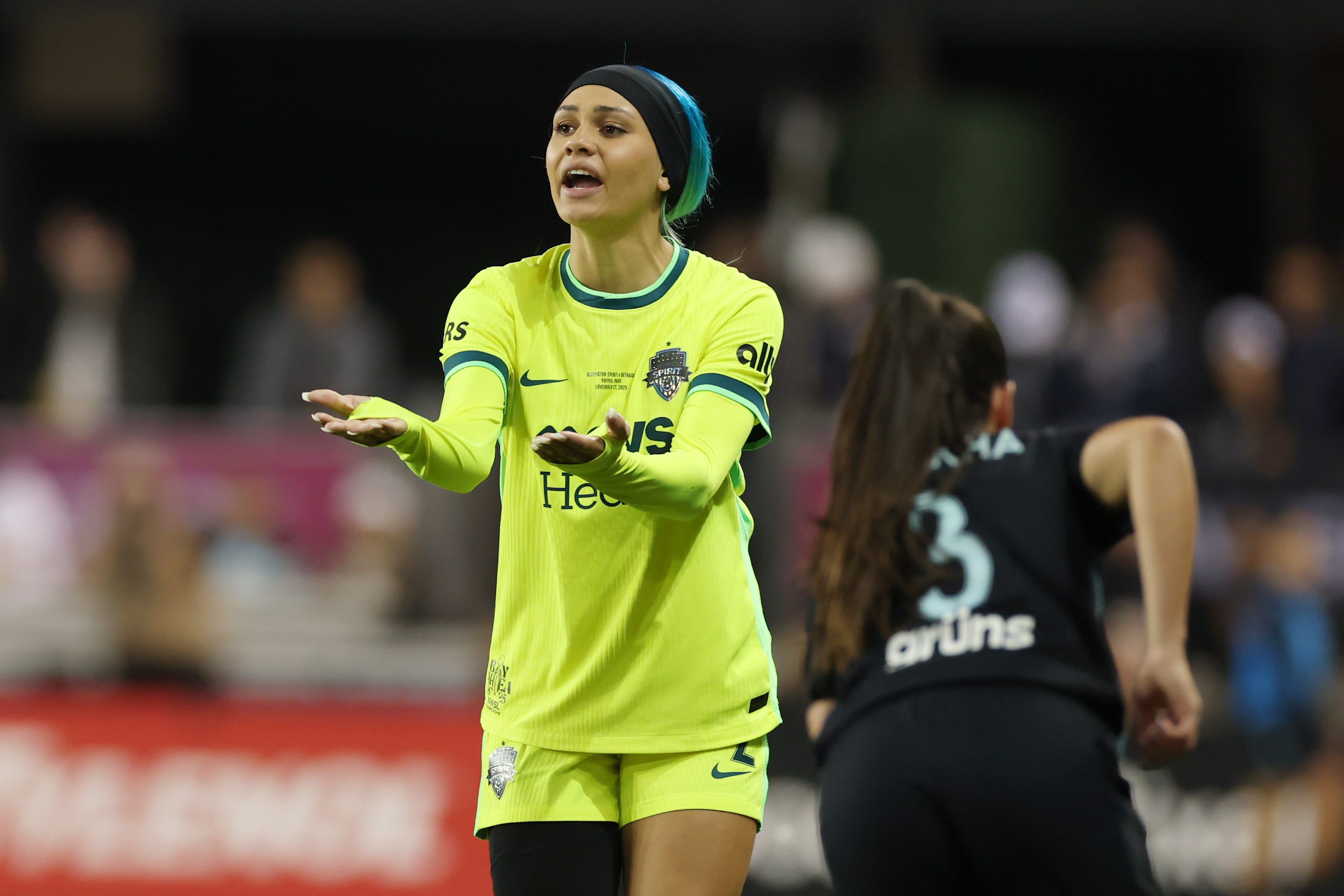
Those salary-cap rules are about to come under some scrutiny as doubt grows over Trinity Rodman’s future in the NWSL.
Rodman, 23, is under contract with Washington Spirit but has attracted interest from leading European teams and from the USL’s forthcoming Gainbridge Super League, with offers said to exceed what the NWSL’s $3.5m team salary cap can accommodate. Berman has publicly stressed that the league “will fight” to keep its biggest stars, while also pointing out that the cap has nearly quadrupled over the past four seasons.
The situation highlights the structural difference between US franchise leagues, where cost controls are designed primarily to protect owners and preserve parity, and European football, where competitive advantage is often defined by a club’s willingness and ability to spend. MLS ultimately introduced designated player mechanisms and other exceptions to keep marquee talent; a similar debate now looms for the NWSL if it begins to lose USWNT-level players in their prime purely for economic reasons.
Any move towards cap exemptions, luxury taxes or designated players would inevitably erode some of the cost certainty that has underpinned NWSL franchise valuations. But if the league is serious about positioning itself as a global destination, rather than a stepping stone to Europe, Rodman’s case may prove an early test of how much financial flexibility owners are prepared to accept in exchange for keeping the game’s biggest names on US soil.
6. Globo and CazéTV share rights for 2027 Women’s World Cup
Fifa has awarded 2027 Women’s World Cup media rights in Brazil to a combination of Globo and digital outlet CazéTV. Globo will show matches on its free-to-air network and pay-TV arm SporTV.
CazéTV, the YouTube- and Twitch-based channel fronted by streamer Casimiro Miguel, will stream all games live across its digital platforms.
The deal mirrors the joint model used for the 2022 and 2023 men’s tournaments in Brazil and reflects Fifa’s push to secure both mass broadcast reach and younger, online audiences for the women’s tournament. It will also demand change from CazéTV, whose existing football output is heavily male-dominated both in tone and on-air talent.
For Fifa and the Brazilian market, the combination of Globo’s scale and CazéTV’s digital engagement should guarantee fantastic visibility for the tournament.
7. Sky Sports Halo and the limits of ‘girlypop’ packaging
It feels like months ago that Sky Sports Halo left this mortal coil. Halo’s bones have been picked enough, but it’s worth noting that Halo isn’t an isolated editorial move from Sky, which is hurtling towards a style ripped wholesale from the various YouTube, TikTok, Reels creators their younger employees have been consuming.
For women’s football in particular, where fans like you are highly engaged with tactical analysis, labour issues and the wider politics of the game, editorial strategies built around vibe and virality risk underestimating both the sophistication and maturity of the audience.
Halo’s abrupt demise may at least sharpen internal conversations about how to innovate in women’s sports coverage without diluting the sport itself.
8. India’s Women’s Cricket World Cup breaks viewing records
India’s victory at the ICC Women’s Cricket World Cup 2025 is not a football story, but its commercial and cultural significance for women’s sport globally is difficult to ignore.
The final against South Africa, played in Navi Mumbai, attracted a record 185 million digital viewers on JioHotstar in India alone, matching the audience for the men’s T20 World Cup 2024 final, and helped drive a total digital reach of 446 million for the tournament. This is more than the combined total of the previous three women’s World Cups.
The scale of those audiences, combined with India’s status as the world’s most populous country and a key growth market for global sponsors, is good news for women’s sport as a whole. If brands and broadcasters start to treat elite women’s sport as a mass-market proposition in India, women’s football may have a chance to get its foot in the door over the coming decades.
For European and North American rights-holders, India’s numbers are a reminder that the next phase of women’s sport growth may be driven by huge gains in emerging markets, rather than continued incremental gains in the west.


