


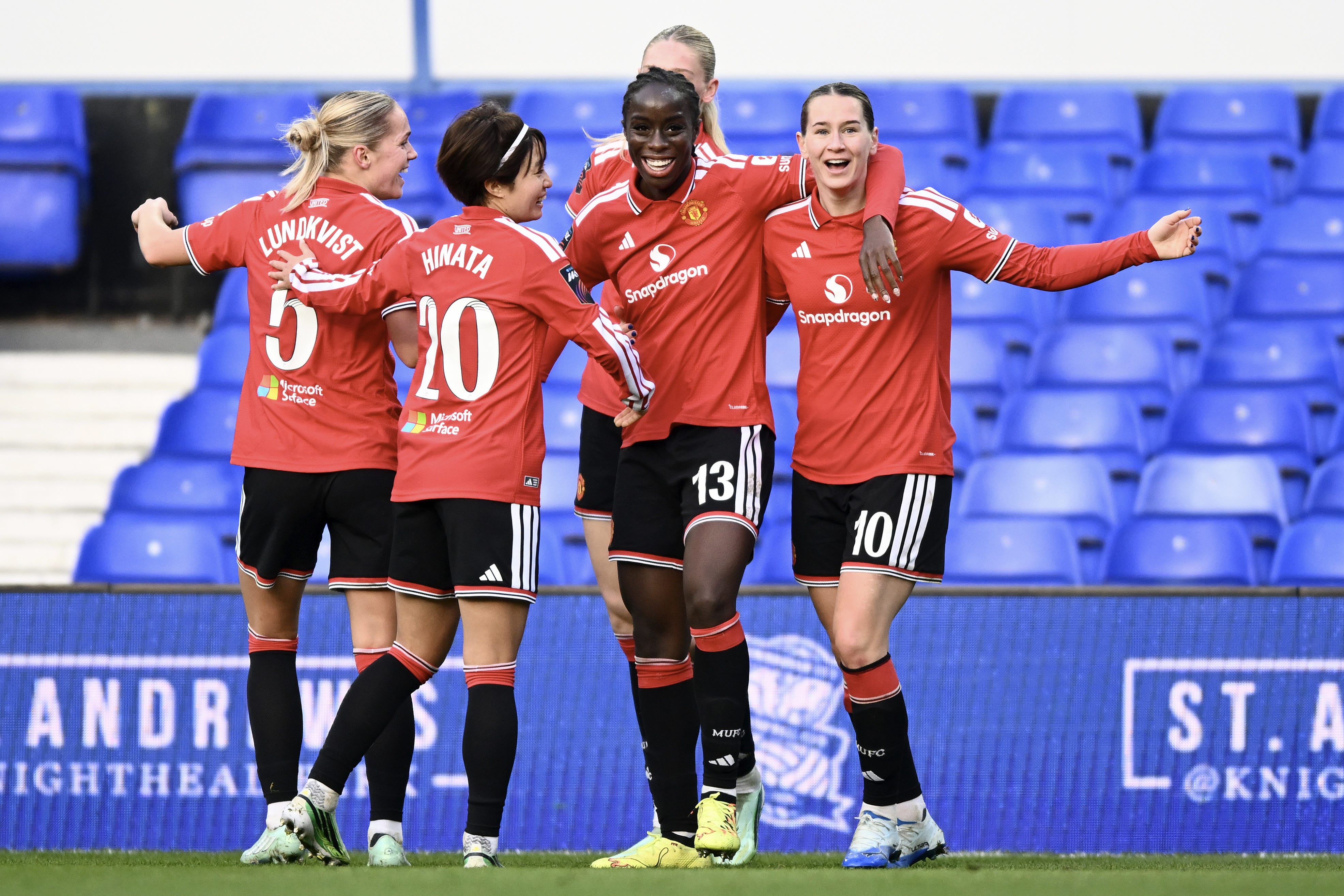
Manchester United registered yet another win under Eva Olid as they delivered a 2-1 victory over Birmingham City to make it 14 games unbeaten in all competitions.
United went behind early on and the story of the game followed a familiar theme, with chances going begging. However, late goals from Elisabeth Terland and Simi Awujo secured all three points and ensured United ended this run of games on a high before the international break.
Here are five things United fans can take away from the game.
Awujo growing into the role
Simi Awujo has raised her level since Eva Olid came in. In recent weeks she has started more regularly alongside Hinata Miyazawa in a deeper midfield role and the new setup looks to be getting the best out of the Canadian, allowing her to add physicality and exceptional ball-carrying ability while increasingly popping up with important goals.
Defensively, she won all five of her aerial duels and made four defensive contributions. Where Awujo excelled in this game, as she has in recent weeks, was with her ability to drive forward with the ball. Birmingham often pushed two players towards her in an attempt to win it back, opening space for Jess Park and Julia Zigiotti Olme as Awujo drew opponents towards her while proving difficult to dispossess.
Her goal came from a corner and some clever movement at the back post. As the delivery came in, Awujo began her run around the penalty spot before peeling away from the Birmingham defenders and attacking the back post. Her header had enough power and precision to secure the win for United.
This deeper role suits her game and her qualities much more than the number 10 position, where she is asked to create opportunities in tighter spaces. Giving her the freedom to pick the ball up deeper and drive forward is bringing out her best qualities. If she maintains these performance levels, she could feel like a new signing for Olid.
Olid presses the right buttons
Midway through the second half, Olid made changes to both the setup and the personnel, all of which helped United turn the game around. It was something she referenced afterwards: “Today the changes worked and made us win the game.”
The first change came at half-time, when United moved towards a more traditional back four, with Anna Sandberg coming on for Celin Bizet and Hanna Lundkvist moving across to right-back, leaving Jayde Riviere higher up as the right winger. The change gave United more options out wide, particularly on the left, where the first goal originated. Sandberg made an underlapping run between Birmingham’s full-back and centre-back before pulling the ball across to find Terland to strike goalwards.
Ella Toone and Layla Drury came on later in the half. While neither got a goal or assist, both made a positive impact on the game, adding energy and forward running against a tiring Birmingham backline. Drury was particularly lively during the 10 minutes she was on the pitch, winning free-kicks and taking the shot that led to the corner from which United scored their last-minute winner.
Another important tactical change was pushing Miyazawa higher. With the back four holding a much higher line, she was able to operate in more advanced areas, which produced some of her best play of the game. Miyazawa’s ability in tight spaces, positional awareness and intelligence in possession are among the best in the squad. Having her playing more advanced sped up United’s play in the final third, with Miyazawa operating in the half-spaces just outside the box and helping link attacks together.
Post-game Olid said: “I think with the changes and changing positions like Hini [Miyazawa] higher, that helped a lot in terms of winning the game.”
The finishing problem is not going away
A recurring discussion that comes up most weeks when watching this United side is the number of chances they create without finishing enough of them. United had 28 shots in the game but only seven were on target. This is becoming a pattern rather than a one-off problem. Against Crystal Palace it was three on target from 22 shots, and against Aston Villa it was seven on target from 18.
The numbers are not great despite the results continuing to come. United sit eighth for shots on target per match, averaging 4.1, with a shot conversion rate of 10%. Only four teams have a lower shot conversion rate than United: Charlton, Everton, West Ham and Birmingham.
There does appear to be improvement from game to game, but the conversion rate is still below what you would expect from the quality United have in forward areas. Getting the ball into the final third is no longer the main problem, with the team moving it much quicker than during the early weeks of the season. The issue is what happens after that.
One week, United are taking shots when there are better options available. The next week, United are overplaying when the shot is on. No two situations are exactly the same, but the decision-making in the final third is still an area that needs to be worked on.
Fourteen unbeaten, and counting
The weekend’s result extended Olid’s unbeaten run to 14 games. After losing her opening two, it represents a remarkable turnaround in both results and performances.
She has shown an ability to adapt, changing systems and working with the squad available to her. In the Players Cup, we’ve seen several younger players given opportunities to prove themselves, with Mared Griffiths and Jess Simpson in particular showing they are ready for more WSL minutes.
Despite the wholesale changes made in some of those cup games, the unbeaten run has continued. That says plenty about the confidence and character in the team right now, with players appearing increasingly comfortable in their roles.
Post-match Olid said: “It was so important mentally to finish this block winning and now we rest; a lot of players are going to the international break. When we are back, today has to be a learning curve, [there are] a lot of things to learn from and improve, I always say. But when we are back, we need to come back fresh, focused and continue.”
The fight never left
Going into this international break, the league table and the wider outlook around United look considerably healthier. One thing that remains undeniable about this United team is its togetherness. It’s word that has been used repeatedly about this group in recent years, reflected in the way the players support and fight for each other through the good periods and the more difficult ones.
The Cutback reported in August that there was frustration among some senior players about the direction the club was taking, and back-to-back poor results at the start of the season could easily have developed into a more serious downward spiral. Instead, since the defeat to Chelsea, United have put together a 14-game unbeaten run, produced some significant performances and repeatedly shown their willingness to fight for each other.
There was a moment in the game against Birmingham that encapsulated that better than anything. In the 81st minute, with the score at 1-1, Park sprinted almost the entire length of the pitch before making a sliding tackle to prevent Océane Hurtré going one-on-one. Only six seconds passed between the initial pass and Park making the challenge.
Post-game Park said: “We all are there for each other, it doesn’t matter who’s doing the job and today that’s what I had to do, so I made the run, and managed to get on the end of it luckily.”
United may lack the financial backing of some of the other teams at the top, but they do not lack perseverance, optimism or cohesion. Those qualities could yet make the difference for this team over the course of the season.
