Searching for rituals: Unpacking The Cutback's new report on the commercial future of women's football
A closer look at The Cutback's new report From visibility to viability: A blueprint for the next phase of women’s football
My mum loves Watford Football Club. They don’t love her back. She goes anyway.
We always meet at the same place and time before home games: Charlie’s Cafe, 90 minutes before kick-off. She wants to be in her seat by the time they play Your Song by Elton John over the PA. Her eyes light up every time she hears it.
Our ritual, built around men’s football, brings her joy like little else. And until recently, there was no hope of changing it.
Watford FC Women have spent the last 12 years touring local seventh-tier grounds in Berkhamsted, Kings Langley and Uxbridge, mostly in front of low three-digit crowds. But in March this year, the club took their first baby steps to modernisation, finally allowing their women’s team a run of fixtures at Vicarage Road to honour their WSL2 promotion charge.
They played those games in front of small but enthusiastic crowds – and it’s no wonder they were small. One solitary email reached my inbox regarding the change. It landed at 3pm on Friday afternoon, two days before their final home game.
To single Watford out for treating their women’s team as a secondary concern would be tremendously unfair. This is just one small example of an endemic problem blighting the club game in every major women’s football market.
It is one of many issues tackled directly by The Cutback’s inaugural report on the state of women’s football in 2026: From visibility to viability: A blueprint for the next phase of women’s football.
The report is built on broadcast, sponsorship and attendance data going back to the 2018-19 season, as well as interviews and surveys with 47 executives and experts working in and around women’s football.
The vast majority of those 47 respondents told us that improving matchday attendances is the key to kickstarting a new phase of growth for women’s football over the next 10 years, but that urgent work is required across all areas of the ecosystem to make that a reality.
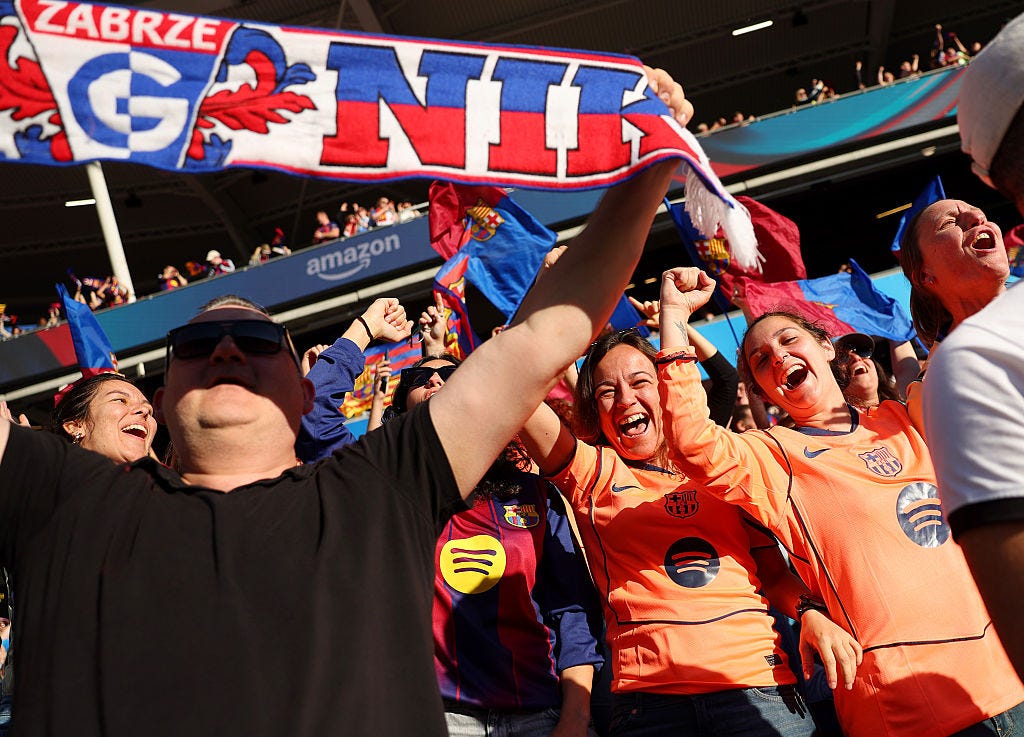
There is no doubt that women’s football has become extremely good at selling big occasions. Millions tune into major tournaments across the UK, the US, Europe and Australia. Tens of thousands pile into stadiums for Champions League knockout rounds and marquee domestic fixtures.
Yet, with only a few exceptions, only a small fraction of those people have embraced the weekly grind of women’s club football, both in-stadium and on TV.
One interviewee provided the clearest summary: “We don’t have a problem with people coming once. We have a problem with people coming twice.”
Visibility and awareness was seen as a problem largely solved across major women’s football markets, with growing participation among girls often cited as the strongest evidence of that fact. However, far too many of those girls attend one club match per season – often a marquee game at a large stadium – and don’t return for less glamorous fixtures, which are often held at lower-tier stadiums on the edges of a team’s catchment area.
Respondents said that women’s football is played in very few “right-sized” stadiums, with clubs often given a stark choice between a 50,000-seat stadium and a lower-tier ground with barely 2,000 seats. Broadcast executives said this is having a huge impact on how women’s club football is perceived. If 25,000 attend a match in a 50,000-capacity stadium, it looks and sounds half-empty. If 4,000 people fill a fifth-tier ground, it looks and sounds like a fifth-tier match.
The sport desperately needs a middle ground: stadiums that give elite athletes an elite stage, while also giving supporters and viewers a chance to create an atmosphere. Brighton’s proposed women’s stadium came up again and again in our research, less as a template for every club than as a sign of the kind of thinking now required.
Sooner or later, women’s club football is going to need its own facilities to thrive, not least because of the scheduling problems it faces. Women’s football is always fighting to fit into gaps in the men’s football calendar, often at the expense of matchgoing fans.
Sunday lunchtime and 2pm kick-offs in the WSL may look good to a broadcast executive, but to the hundreds of thousands of girls playing football on Sunday mornings, it makes attending a match that much harder.
Midweek European nights in the Women’s Champions League are a direct inheritance from men’s football, but several respondents questioned why these are necessary, with short domestic league seasons theoretically making weekend UWCL games much easier to schedule.
Not every match can be scheduled perfectly for the current primary audience of women’s club football: families with children. However, respondents told us that reducing the target audience of women’s football in this way is a limiting approach. Families have given women’s football much of its warmth and early momentum, and the LGBTQ+ community has helped build atmospheres that feel more open than many spaces in men’s football.
However, respondents believe that women’s football – especially women’s football clubs – are missing a trick by not heavily marketing to teenagers, millennial professionals and existing men’s football fans that have been priced out of watching their team every week. Currently, many of those men are drifting away to local non-league football clubs without much protest from their old clubs, whose women’s sides would kill to have them attend.
That ambivalence is also cited as a major issue for women’s club football, with many male club CEOs across England, Europe and further afield still unconvinced that women’s football is worth paying any attention to. Many reported that efforts to improve the women’s side of the club comes from the bottom up, rather than the top down. None of the respondents said this as a good thing.
When the impetus does come from the top down, success stories have been made. Arsenal, Lyon and Barcelona dominate the European arena thanks to well-funded and well-cared-for women’s football teams. Other well-funded clubs, like Real Madrid, receive little more than subsidy.
The NWSL was cited consistently as a useful reference point for European club football, albeit with the caveat that the closed US system provided advantages for those wanting to invest heavily in a club over the longer term.
Europe shouldn’t import the American model, but the work done to build fanbases, brands and marketing lists from scratch now stand NWSL clubs in good stead for the future – they have grafted and learned how to sell women’s football to a brand-new audience, something that most European clubs still have little interest in doing.
However, there is good news. Women’s football is still growing. Brands still want to attach themselves to the game and are learning, slowly, that they can get return for their investment if they stay the course over a long period of time.
The millions of girls watching women’s football around the world will one day grow up to make their own choices with their money and time, and provided that matches continue to be made widely available, a tidal wave of new fans willing to pay to watch will sweep through over the next 10 to 20 years.
In the meantime, there are people in every football club’s orbit that could be convinced to make women’s football part of their ritual.
Some will be young enough to build that habit from scratch. Others, like my mum, need more of a nudge than a Friday afternoon email.


