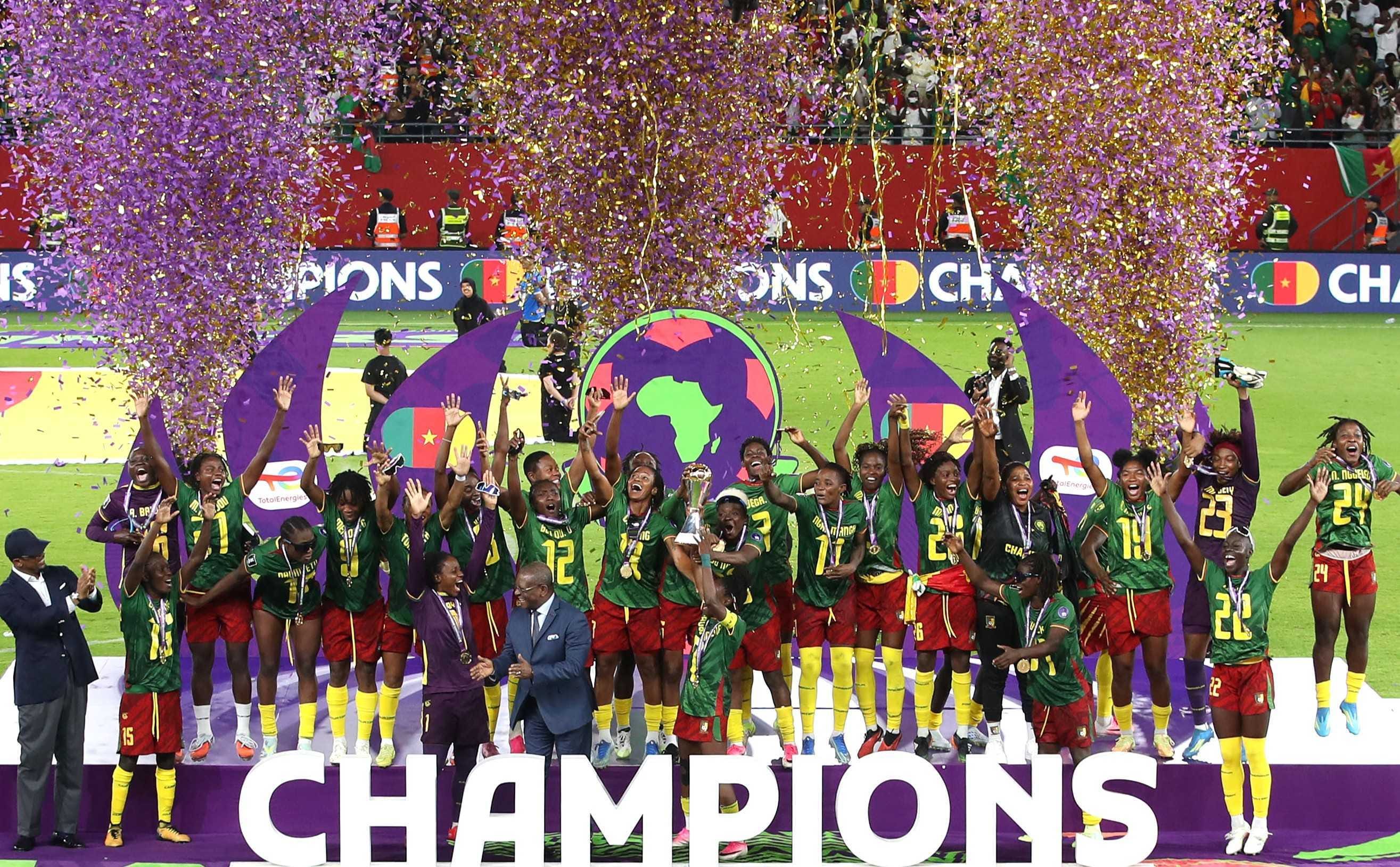
WAFCON 2026: Cameroon outclass debutants Malawi to claim first title
Indomitable Lionesses finally get over the line with 3-0 win over Malawi as dramatic WAFCON comes to a close.
Moulay El Hassan Stadium, Rabat
Cameroon have secured their first Women’s Africa Cup of Nations (WAFCON) title defeating Malawi 3-0 in Rabat on Sunday night.
This was an unexpected final between a team that failed to qualify for the tournament in Cameroon, and WAFCON debutants Malawi. Whatever happened at the Moulay El Hassan Stadium a shock was guaranteed, and the luminaries of African football turned up to witness the coronation.
Cameroonian Football Federation president Samuel Eto’o, CAF President Patrice Motsepe and under pressure Fifa President Gianni Infantino were but a few faces among the dignitaries. A strong contingent of Cameroonian fans, a good few lively Malawi supporters as well as a smattering of neutrals filled out a decent proportion of the stands.
The contest got off to an even start, with Temwa Chawinga keeping the Cameroonian defenders on their toes with her runs in behind. The Indomitable Lionesses soon grew their threat and opened the scoring 20 minutes in. Goalkeeper Mercy Sikele could only push a first-time shot onto the crossbar, and it dropped right down for Marie Divine Ngah Manga to head home from close range.
Right winger Naomi Eto soon added a second through a fantastic finish from a corner, putting Cameroon in a more commanding position. From thereon, only one result looked likely.
Ngah Manga scored another on the stroke of half-time after the ball was laid on a plate for her by right-back Yvana Makana. The young striker could have completed her hat-trick minutes after the break as she went clean through on goal and rounded the keeper, but somehow missed an empty net.
That will matter little in the grand scheme of things. The only time Malawi really threatened to stage a comeback was in the 61st minute when the Chawinga sisters broke forward and both got shots off, but Michaely Bihina denied Tabitha, while Temwa missed wide on the spin.
Cameroon’s night was nearly capped off with even more magic when captain Gabrielle Onguéné, appearing in her eight WAFCON at 37 years old, came on during stoppage time. One of two players who were part of the team that lost the 2016 final on home soil, she got to soak it all in and even put the ball in the back of the net, sparking delirious celebrations. However, the assistant referee’s flag was up for offside, ending a bonus Cinderella moment for Cameroon. Finally, after losing three finals, they are African champions.

What defined Cameroon’s match?
Focused threat down the right wing.
Cameroon had a clear game plan from the off, as they seemed to identify a weakness in their opponents’ structure and channelled their attacks to try and exploit it.
Makana looked to push forward out of the build-up, with right-sided centre-back Maëva Nyadjou moving towards the space she vacated to play forward balls using her expansive range of passing. Eto stayed very high and looked to attack the space in behind, consistently getting into dangerous positions.
As they had done in the previous game, Malawi looked to keep Tabitha Chawinga high to make the most of her counter-attacking threat. As a result, though, they left left-back Ireen Khumalo isolated against the Cameroonian assault, and she stood no chance against the numerical overload she faced.
Right winger Eto played a key part in the build-up to the opener and it was her finish that doubled the lead in 29th minute.
What defined Malawi’s match?
An inability to control possession.
Defending has never been Malawi’s strong point; they haven’t kept a single clean sheet all tournament despite making it all the way to the final. They didn’t do a good job of shielding their fragile back line with their approach in possession, and were punished.
The Scorchers always look more threatening in end-to-end sequences, in which their star forwards can fully stretch their legs and show their quality against isolated defenders. They had been able to do that in their run to the WAFCON final but struggled to do that on Sunday night.
Having conceded first, Malawi needed to put their foot on the ball and establish some control over possession. Cameroon retreated with their defensive block to close out the spaces in behind, rendering direct balls far less effective. However, the Scorchers did not tweak their approach, and likely lost the game as a result.
For one, Malawi’s attacking chances dried up as Cameroon’s defenders consistently cleared their forward balls away, with Temwa Chawinga naturally ineffective as an aerial target. Worse yet, they were then left exposed to counter attacks. It was a fast break that led to the third goal, and left an impossible mountain to climb.
Lovemore Fazilu’s side did come out of the break with some tactical tweaks, notably pushing Tabitha Chawinga higher up alongside her sister. They did look better in possession and created a couple of presentable chances, but were still shut out for the first time in the tournament.
What will this WAFCON be remembered for?
Despite the on-field drama delivering throughout the tournament, CAF and Morocco didn’t give the competition the platform it deserved
This was arguably the greatest edition of WAFCON in its over three-decade-long history as all expectations were defied and destroyed on the pitch. Off the field, however, the organisers could have done a much better job of making it all the more memorable.
Outside of Morocco’s games, matches were poorly attended and Sunday’s final failed to sell out. There were large sections of Malawi and Cameroon fans that were making enough noise to fill up the 22,000-seater stadium, but the venue still failed to look full.
It’s not surprising given the chaotic build up to the tournament.
The 2024 WAFCON was delayed by 19 months to avoid clashes with the Paris Olympic Games, and saw Nigeria dramatically triumph over the hosts last year. In true CAF fashion, this year’s tournament was also delayed, as the confederation postponed WAFCON 2026 just 12 days before it was originally scheduled to kick off in March – this time blaming “certain unforeseen circumstances” and refusing to elaborate further.
CAF has also made sure that qualification for the tournament was just as disorganised. Only 11 teams qualified for the 2026 WAFCON to join hosts Morocco, but CAF later amended the tournament to ensure the four highest-ranked teams that didn’t qualify were later added to make it a 16-team competition.
Despite getting extra time to prepare for the tournament, it was hard to even know that WAFCON was happening in Morocco. There was absolutely no advertisement of it in any part of the host cities, including the facades of some of the host stadia.
The confusion around broadcast rights also added an extra layer of messiness. CAF's pre-emptive announcement of UK broadcaster Channel 4 picking up rights to the tournament was eventually confirmed, but only once the knockout stages had begun.
There is by no means a lack of interest in hosting WAFCON – the likes of South Africa, Tanzania and Kenya have all shown some interest in the last few months – but CAF’s failure to confirm a proper bidding timeline has left them with few choices. Case in point: they are already inviting bids for men’s AFCONs as far as 2036, but have yet to put anything out for WAFCON 2028.
What next?
While the players head back to their new clubs to kick off a new season or continue the ongoing one, all the WAFCON participants will turn their attention to the 2028 Olympic qualifiers. They will feature in the 32-team second round in October, with the aim of making it all the way to the fifth round and becoming one of Africa’s two representatives in Los Angeles. Meanwhile, Ghana and South Africa will also enter the 2027 World Cup inter-confederation play-offs in November, hoping to join the four semi-finalists in Brazil next year.


