WAFCON 2026 group stage roundup: Nigeria and South Africa scrape through, Malawi make history
Favourites put under pressure in first phase of WAFCON

One of the most dramatic group stages in WAFCON history has concluded with the favourites just about going through, setting up an unexpected knockout bracket.
Group A
Two matchdays in, Group A was going exactly as predicted.
Morocco started their campaign off with a comfortable four-goal win over Kenya in what was the latter’s only WAFCON appearance other than 2016. The hosts faced a much sterner test in their second game from an Algeria side on a run of five straight WAFCON clean sheets, but Sanaâ Mssoudy’s late goal made it two wins from two.
Algeria’s defeat wasn’t a tournament-killer as they opened their campaign with a 2-0 victory over Senegal. The Lionesses of Teranga, in turn, went on to defeat Kenya thanks to Seynabou Mbengue’s lone strike, keeping themselves in the hunt for a knockout spot. However, Senegal still had to face Morocco, who had looked like the best team at the tournament to that point.
Mame Cissé’s side earned a point against the hosts thanks to a spirited display, posing a consistent threat on the break and coming very close to scoring on a couple of occasions. Morocco showed their quality throughout and kept the ball well, but their star-studded front four (which included captain Ghizlane Chebbak in place of teenage starlet Kautar Azraf) couldn’t find a way past Adji Ndiaye in goal.
The 19-year-old shot-stopper put together one of the performances of the tournament, keeping out two Yasmin Mrabet penalties (the second one being a retake) as well as a host of set-pieces to earn a hard-fought clean sheet.
Despite that, the point was not enough for Senegal to progress. Marine Dafeur’s sensational free-kick set Algeria on course for a 2-0 win over Kenya, and with it, second spot in the group.
Group B
Tanzania produced the first upset of this WAFCON by defeating 2022 champions South Africa in the Group B opener.
Banyana Banyana looked just as lacklustre as they had done during qualifying, while the Twiga Stars produced a few moments of brilliance. Diana Msewa and substitute Hasnath Ubamba each scored after mazy dribbles, and goalkeeper Najiati Idrisa came up clutch to help seal their first-ever WAFCON win.
South Africa found themselves in a must-win situation on Matchday 2, when they took on a Côte d’Ivoire side that had dispatched Burkina Faso 4-1 in their opener. Les Éléphantes assumed a two-goal lead through teenage midfielder Sery Grace Ruth, but dropped off in the second half. Banyana Banyana’s Thembi Kgatlana halved the deficit in the 71st minute, before substitute Hildah Magaia equalised nine minutes into stoppage time.
A point left South Africa on the brink, but Burkina Faso’s surprise win over Tanzania kept them in the running. The 2022 champions had to win their final group game and also needed a favourable result on the other side of the city.
Kgatlana scored again in a tense one-goal win over Burkina Faso, while Tanzania’s loss took Banyana Banyana through to the knockouts alongside Côte d’Ivoire.
Group C
Billed as the group of death coming into the tournament, Group C lived up to the hype and then some.
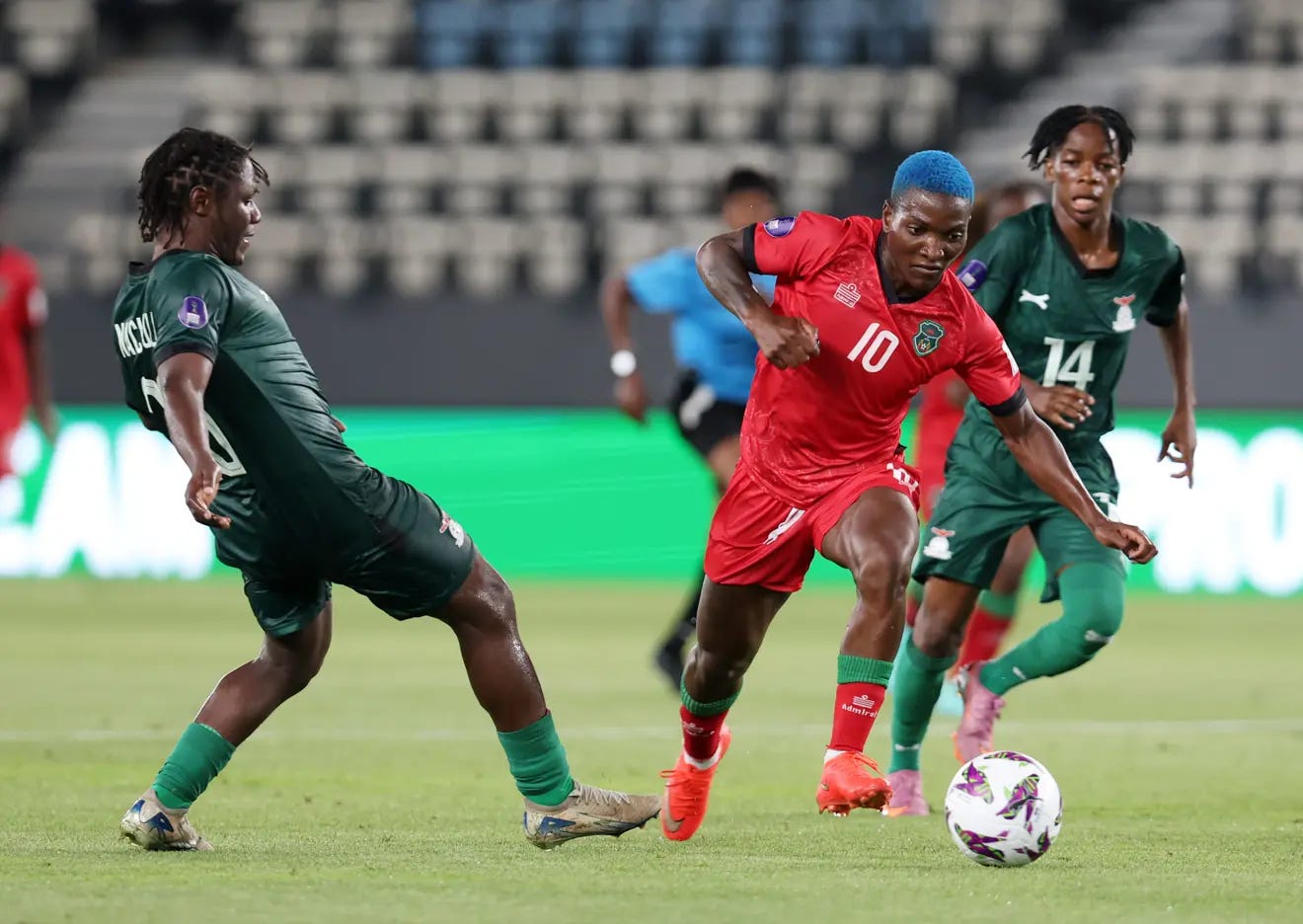
It was blown wide open on the very first day as world #153 Malawi shocked 10-time champions Nigeria on their major tournament debut. A brace from superstar striker Temwa Chawinga as well as a strike from sister Tabitha led the Scorchers to an unforgettable 3-2 win, completing one of the biggest upsets in WAFCON history. Zambia, meanwhile, produced a statement of intent themselves, hitting Egypt for six.
Malawi played first on Matchday 2 and eased past Egypt, effectively putting Nigeria in a must-win scenario as they took on Zambia. Super Falcons coach Justine Madugu knew it, too. He made five changes to the XI, including a return for veteran striker Asisat Oshoala, who took just eight minutes to open the scoring by running onto a through ball.
Zambia star Barbra Banda was a menace to the Nigerian back line throughout, and drew a red card from Oluwatosin Demehin before half-time. However, it would be on the other side of the break that her side registered their first attempt of the match, and they ultimately couldn’t pose enough of an attacking threat to equalise.
All four teams remained mathematically in contention for the knockouts before the third matchday, but the tournament’s tiebreaker rules complicated matters for all involved. WAFCON group tiebreakers rely solely on head-to-head records, including goal difference and goals scored against specific opposition.
Nigeria had to beat Egypt and then hope for anything other than a one-goal victory for Zambia at a scoreline of 4-3 or higher, which would have dumped them out. The Super Falcons dispatched the Cleopatras 6-2, leaving the other two challengers to battle it out.
Zambia took the lead over Malawi just two minutes in through Barbra Banda, whose powerful shot was spilt into her own net by goalkeeper Mercy Sikelo. The Copper Queens continued to look the more threatening team, and scored the crucial second goal through Prisca Chilufya before half-time, moving into the top two as things stood.
Malawi’s threat was subdued for the most part, but Tabitha Chawinga scored an all-important goal in the 73rd minute that brought the goal difference down to a favourable number for Zambia, albeit without the necessary amount of goals scored.
As the match ended 2-1 to Zambia, both sides were left looking to the touchline for answers. Word quickly reached the pitch that Zambia had not done enough, and Malawi celebrated their fairytale qualification as group winners.
Group D
Group D appeared to be the most open of the four coming into the tournament, but it ended up with little drama.
Cameroon, who failed to qualify for WAFCON before receiving an invitation as part of the tournament’s expansion to 16 teams, became the first side to seal a knockout berth by winning their first two games against Mali and Ghana.
Valentine Nguele, who was only appointed as the team’s full-time head coach a month before the tournament, is already reaping rewards for putting together a well-drilled side with a blend of experience and young talent.
Debutantes Cape Verde lost their first two group games against Mali and Ghana, though they put up a fight in their 3-2 loss to the former and went on to earn a historic first point against Cameroon.
Mali had to win in their decisive third-round clash against Ghana, for whom a point was as good as three. After a scrappy start, the Black Queens grew more of an attacking threat — particularly down their right flank. Evelyn Badu scored what would prove to be the decisive goal on the stroke of half-time with a well-guided header at the end of right-back Comfort Yeboah’s whipped cross. Substitute Kadidiatou Diabaté equalised with a deflected free-kick just a few minutes after the break, but Mali failed to pose a sustained attacking threat and ultimately fell short.
Looking ahead to the quarter-finals
The four quarter-finals will also serve as de facto World Cup qualifying playoffs, since only the winners will earn direct tickets to Brazil. The defeated sides will first compete in a play-off match against one another next week to decide the two African representatives at the inter-confederation play-offs.
The headline fixture of the next round has to be Morocco vs South Africa — a repeat of the 2022 final. The hosts will certainly be the favourites given Banyana Banyana’s subpar group stage campaign, but will have to bring their A game against a side that has not lost a WAFCON knockout game outside of penalties in close to a decade.
On the same side of the draw, Nigeria will take on Group D winners Cameroon in a repeat of the 2016 final. Côte d’Ivoire will face Algeria on the other side of the bracket, with the winner set to meet Malawi or Ghana in the semi-final.


