



Arsenal’s disappointing start to the WSL campaign continued at Stamford Bridge on Sunday, as a 1-0 defeat to Chelsea leaves the Gunners seven points off league leaders Manchester City.
Having been held to back-to-back home draws against Crystal Palace and Manchester United, this match provided an opportunity for the Gunners to kickstart their season. Defeat means that Slegers’ team are already facing an uphill task to get their floundering campaign back on track, having delivered just five points from their opening four WSL games.
The Gunners made a similarly poor start two seasons ago under Jonas Eidevall, winning just one of their opening five matches in all competitions. It was a 2-1 defeat to Chelsea at the Emirates that saw Eidevall resign in October 2024. Slegers will have to pull out a big result away to Manchester City on Sunday to avoid the same noise circling around her future.
Like her predecessor, Slegers is now scrambling for a solution as her team’s season threatens to spiral out of control, and her starting lineup selected at Stamford Bridge reflected that.
For the fourth consecutive match this season, Slegers made changes both to the midfield and out wide. Additionally, Anneke Borbe replaced Misa Rodriguez in goal. Slegers chose to pack her team with technical quality, starting a midfield three of Kyra Cooney-Cross, Georgia Stanway, and Kim Little, with Mariona Caldentey playing off the left. Kim Little started the match in the No 10 role, but at times Arsenal’s shape would closer resemble a six and two eights model, with Cooney-Cross anchoring at the base, flanked on either side by Stanway and Little. In the first 30 minutes, this technical base, combined with purposeful pressing, allowed Arsenal to take control of the match, creating promising situations. Even then, Arsenal struggled to convert these situations into clear cut chances, hitting the post twice.
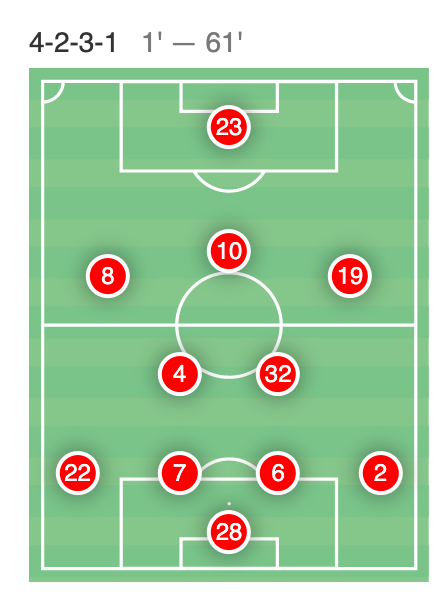
This good spell wouldn’t last, as Chelsea eventually settled into the match, finding a way to play through the press, before taking the lead through Alyssa Thompson six minutes before halftime. From that point on, Arsenal were a shadow of themselves as they attempted to get back into the match. The second half possession stats tell their own story. Arsenal had just 38% of the ball as Chelsea were able to keep them at arms length. Slegers choice of subs felt like more a hinderance than a help, with technical security sacrificed in search of attacking thrust which never materialised.

