World Sevens delivers London party but long-term identity remains unclear
Third edition of seven-a-side tournament was a hit with players and fans

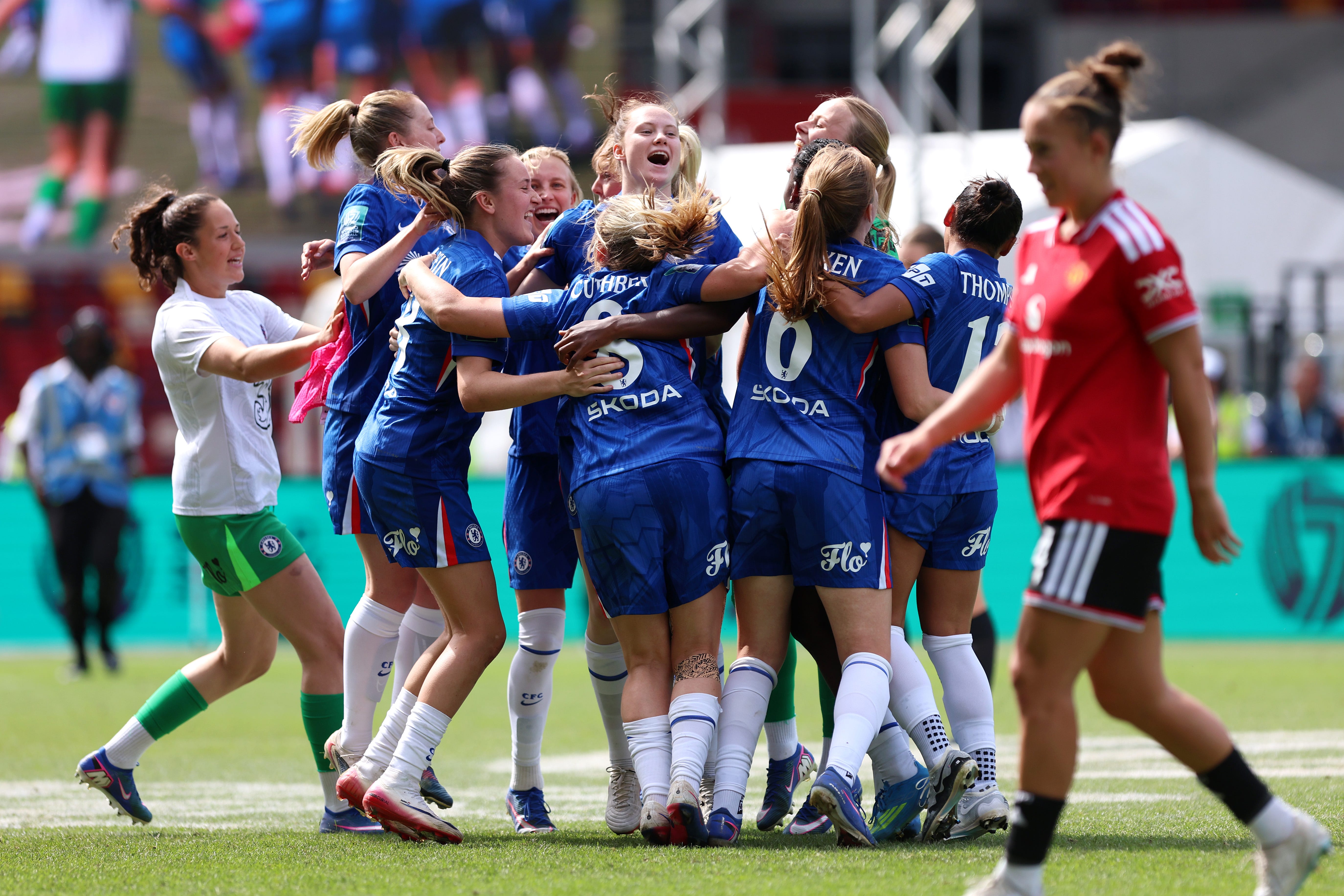
Chelsea claimed the third edition of World Sevens Football in front of a rowdy crowd at the Brentford Community Stadium in west London on Saturday.
Sonia Bompastor’s side beat Manchester United 6-5 in the final thanks to a late Aggie Beever-Jones goal.
This year’s tournament was the busiest and loudest yet, despite being a regional edition featuring only WSL sides. Squeezed into the days leading up to Sunday’s Women’s FA Cup final, the event tapped into the celebratory atmosphere that always arrives before the showpiece game at Wembley.
The first edition in Estoril, Portugal, last May had just two WSL sides taking part alongside Ajax, Benfica, PSG, Rosengård, Roma and Bayern Munich.
Much of the narrative around the inaugural edition centred on the prize pot and what it offered players, some of whom do not earn the sort of eye-watering salaries seen at top WSL clubs.
As winners in Portugal, Bayern Munich took home £1.8m ($2.5m) and runners-up Manchester United claimed £740,000 ($1m). This year, the prize pot has been cut on the basis that it is a regional edition, with the winners earning £372,000 ($500,000) and the runners-up £186,000 ($250,000).
The team walkouts, which have become must-see in the stadium and on social media, were once again the biggest draw of the competition’s three days. Fans, media and club staff were desperate to catch a glimpse of what weird and wacky things each team had planned.
The highlights were Hannah Blundell’s WWE-inspired coffin moment before Everton’s semi-final against her former club, Manchester United, and Chelsea’s final walkout, which nodded to some of the club’s most viral moments and featured head coach Sonia Bompastor holding a TV camera.
Backed by Justin Fishkin and Jennifer Mackesy, a minority owner of Gotham and Chelsea, W7F is following the trend of the aforementioned “sportainment” small-sided football concepts that have appeared around the world.
Unlike Baller League, which is tailored towards Gen Alpha with a focus on YouTubers and influencers, W7F is made up of eight established football clubs. On the pitch, there is a focus on existing fanbases, stars and rivalries, while the social content is very much focused on meeting the demands of the next-generation fan.
There is no denying that those on the pitch and in the stands are having the time of their lives during this festival of football. The game rarely breaks free from the intensity and tradition of the endless grind of the calendar, but with that calendar come constraints.
Fifa’s creation of the Women’s Club World Cup and Fifa Champions Cup, which has been thrown into a January-February slot, has wreaked havoc on the already congested schedules of many of women’s football’s global leagues.
The Arnold Clark Cup, created by sports rights agency Pitch International and the FA, managed only two editions before Uefa’s creation of the Women’s Nations League took over the slot that the invitational international tournament was trying to occupy.
At present, there is no official governing body for sevens and neither Uefa nor Fifa has shown interest in formalising this iteration of the sport.
While that remains the case, World Sevens can continue to take its event on the road, but it is unclear what counts as success for an event that may struggle to sustain long-term relevance and interest. World Sevens is an end-of-season celebration that requires individual club buy-in, which is likely to become harder as the calendar becomes busier and with a 2027 Women’s World Cup on the horizon.
Where does the event go from here? London has easily been its most successful edition, but what will be required to ensure there is longevity beyond these short, sharp bursts? Does the event need to lean more into the Baller League model, with regular tournaments in an arena-style setting? Are new franchises the way forward? Is it truly global when there are just eight WSL sides taking part?
Of the head coaches involved, Manchester United’s Marc Skinner has been one of the event’s biggest advocates, acknowledging the positive impact it can have on squad chemistry and insisting that United would like to be involved in all future editions.
The event is still in its test-and-learn phase. It is not perfect, and that is part of the charm. But it is hard to see what the future holds for something that feels like a joyful school trip or sports tour. It is welcome, but there is a sense that it may struggle to stick around.


