


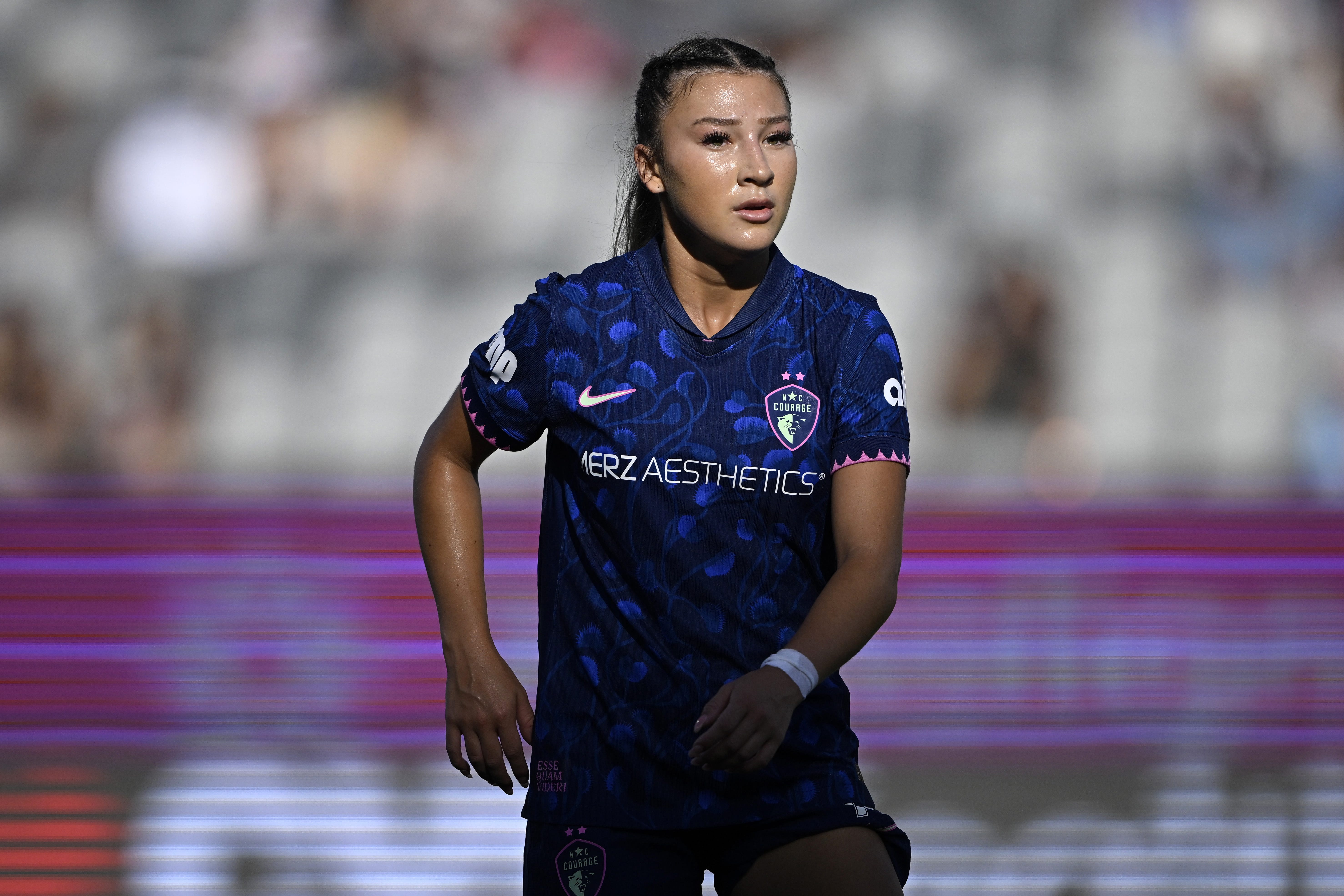
When St. Albans native Anouk Denton arrived in the NWSL, she raved about how teams never went into games knowing what the result would be.
The league’s parity is one of its major strengths compared to European leagues, and Denton said it was one of the main reasons she switched after playing in the WSL.
“I was really excited to come to the NWSL,” Denton said. “How competitive the league is was the biggest part that pulled me in.”
“There’s no favourites. really. Anyone can win any game, so there is always everything to play for.”
Denton is one of several English youngsters who have moved overseas to the NWSL in recent years, and the league has welcomed them with open arms. While young players making the trip across the Atlantic still isn’t commonplace, it appears to be a growing trend as young English players look for development opportunities outside the WSL.
Unlike England’s WSL, the NWSL thrives more on transition than on tactical play (though that’s changing); it offers more consistent week-to-week competition. Only four teams have ever won the WSL title since it began play in 2011, while four different teams have won the NWSL Championship in just the past five years.
Competition for places in England is another reason why young players are looking abroad. WSL academy players are increasingly losing playing time as the league continues to attract older, elite footballers from other leagues. The Athletic recently reported that just 15 per cent of WSL Football’s record 86 debutants last season progressed through the academy of the team with which they made their debut.
This summer, the WSL has seen more transfer movement than ever before as teams look to improve their squads, but in doing so are preventing their own academy players from playing senior minutes.
The NWSL has recently become a release valve for young players at a dead end, as players younger than 18 have been permitted to play in the league since 2021. The infrastructure and training facilities on offer – especially compared with many WSL 2 clubs – also lure many young players from England.
The North Carolina Courage’s Erica Meg Parkinson, who received her first senior England call-up in March after starring for the youth national team, signed with the North Carolina Courage in July, after spending two years in the Portuguese first division. She signed with the Courage on a contract through 2029 with a club option for 2030.
“I thought that they were a very organised club,” the 18-year-old said after joining the Courage. “They had a really good plan for me, and there was something that aligned with what I look for as a player.”
While Parkinson wasn’t in the WSL at the time of her switch, The Cutback understands there was interest in her from several of the WSL’s ‘big four’ sides including Manchester United, before Parkinson eventually chose the Courage.
A recent mini injury crisis at the Courage has seen Parkinson break into the starting line up. She’s started 10 of the Courage’s last 11 games, bagging two assists.
One player agent, who wanted to remain anonymous to protect relationships, told The Cutback, that the NWSL offers a strong minimum standard of world-class facilities and high level coaching for young players, across the board.
“Playing time, trust and minutes is one thing, but with the Collective Bargaining Agreement (CBA) there’s guaranteed investment and standards off the pitch.”
They added, “there’s a trust in young talent, they understand they will make mistakes. Of course in the NWSL there is still pressure from owners to win now and make playoffs, but in the WSL it feels that everything is so short term, on a game by game basis.”
Bay FC’s Keira Barry, who previously played for Manchester United, spoke about Bay FC’s values when deciding to play for English manager Emma Coates, who previously managed England’s under-23 team.
“It was clear that the club’s values, ambition and people aligned with what I’m looking for at this stage of my career,” Barry said. “I’m excited for the challenge of playing in a new league, testing myself against top players and experiencing life in the U.S. I believe this is the perfect environment to continue pushing my game forward.”
Barry, who received her first senior international call-up in April for two World Cup qualifying matches after playing with England’s youth national teams, signed her four-year NWSL contract in February.
This season, Barry has scored two goals in 18 appearances, with 14 of those coming from the bench.
“When the opportunity to join Bay FC came up,” Barry said, “it felt like the right move straight away.”
Denton, whose signing was also announced in February, had previously been part of Arsenal’s academy before moving up to the first team as a 17-year-old in 2020. After her loan spell with West Ham in 2021, she chose to play college soccer at Louisville before going back to West Ham.
Denton has represented England at the under-23 level under Coates and the under-19 level with Bay FC assistant Gemma Davies. She was called up to the senior national team for the first time in October 2025 and earned her first cap in a 2-0 win over Ghana in December 2025.
Denton touted Bay FC’s vision and the NWSL as a whole after signing.
“The NWSL is the most competitive league in the world,” Denton said, “and I’m excited to challenge myself against top players and teams.”
So far, Denton has appeared in eight matches for Bay, starting six of them.
Finally, the San Diego Wave’s July acquisition of Laila Harbert from Arsenal after a loan stint with Everton brought her back to the league and caused a stir amongst Arsenal fans who questioned the route into the club’s first team for academy talent.
Harbert wasn’t the only Arsenal youngster to leave this summer, with Vivienne Lia joining Eintracht Frankfurt in Germany, Niamh Peacock heading to West Ham, and goalkeeper Naomi Williams departing at the end of her contract.
On signing the 19-year-old Harbert, Wave sporting director and general manager Camille Ashton said: “She’s an exciting young talent with exceptional technical quality, vision, and composure under pressure.”
Harbert has been a key player for England at youth level, playing at under-19 level and starting every match as the team qualified for the U-20 World Cup. She also previously captained the under-17 team.
Both Parkinson and Harbert stayed with their clubs during England’s recent run to the round of 16 in the U-20 World Cup in Poland, and their absence saw them both pick up minutes int the NWSL.
Time will tell how the decision to play in the NWSL works out for these English youngsters.
