


You’ll have heard by now that women’s club football in Europe has an attendance crisis.
Average attendances are declining in the WSL and are largely stagnant in other major competitions, and this statistic is often used to show that interest in women’s football has either stalled or declined.
However, once you scratch beneath the surface of those average attendance numbers, you’ll find that it is casual ‘fans’ that are losing interest in women’s football, while the core fanbase for the product has consolidated after huge growth since 2019.
The decline in attendances for marquee women’s club football fixtures has had a huge impact on those numbers doing the rounds and there is plenty of head-scratching about why this is happening. You’ll often hear that kick-off times, men’s football clashes, ticket prices and stadium availability are primary causes for the decline.
They all have an impact, but The Cutback would like to posit another reason: the ‘children and families’ touted as the primary audience for women’s football have either gotten bored or aged out of this particular brand of family fun.
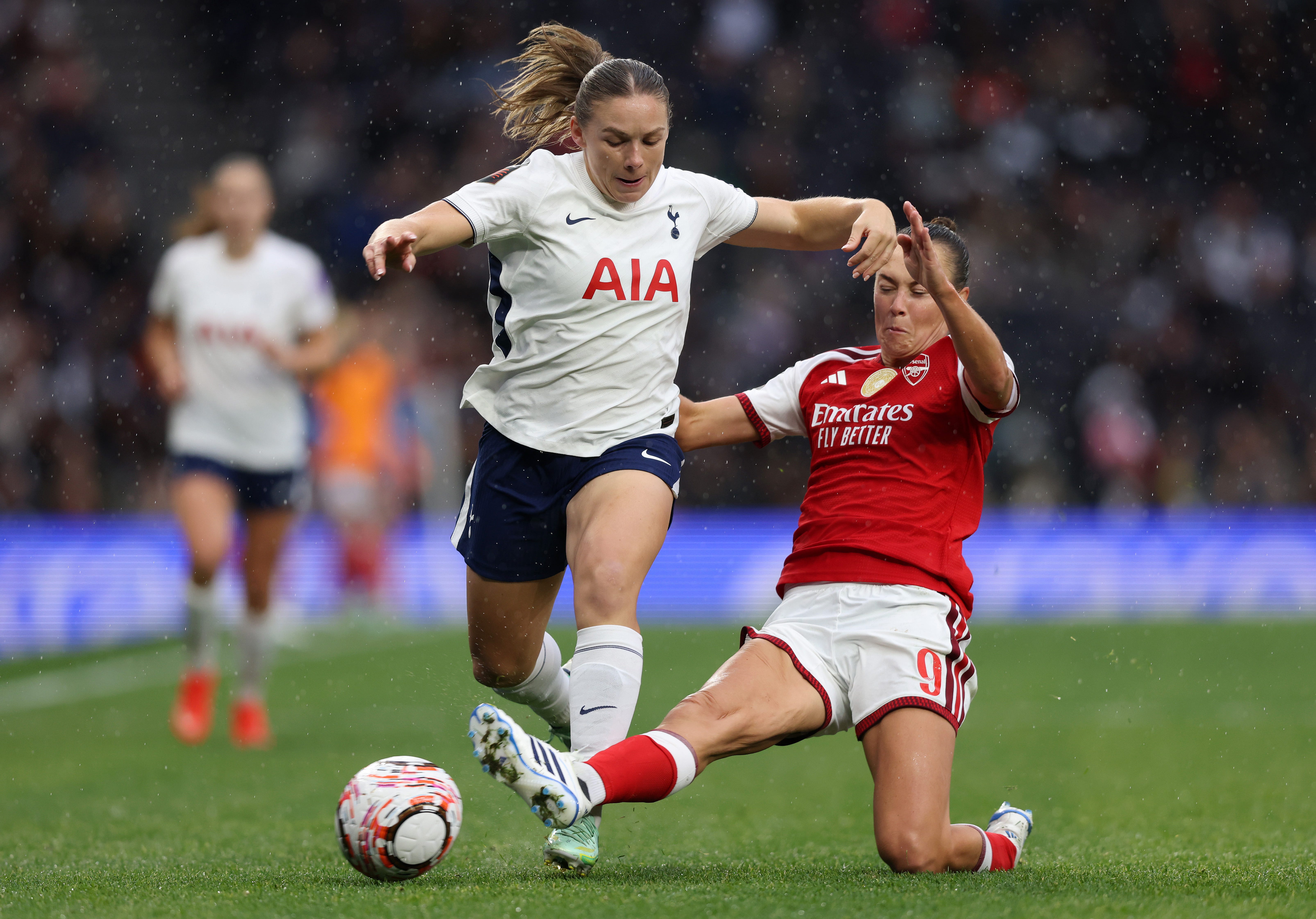
The north London derby two weekends ago was a prime example of how not to market a women’s football match in 2026. Just 13,719 people attended the Tottenham Hotspur stadium two weekends ago, and that included an impressive travelling contingent of around 4,000 hardcore Arsenal supporters who sold out their away allocation for the first time.
To entice home fans to attend, Spurs promoted DJs, face painting, giveaways, mascots and other attractions consistent with cheap half-term entertainment, rather than the attraction of world-class footballers competing in one of football’s fiercest rivalries.
These strategies worked in the past when women’s football was a novelty. In fact, the entire marketing campaign for 2026 was rinsed and repeated almost verbatim from the inaugural WSL north London derby in 2019, which attracted over 38,000 people to the same stadium, albeit during a men’s international break.
It’s becoming clear that this kind of marketing doesn’t cut it any more. Women’s football in the big stadium used to be a brand new thing to see as a family, but most of the target audience have now seen it and moved on to other things — the kids have gotten older and are making their own plans, while the parents never had any intention to continue attending matches of their own volition.
It is beyond time for women’s football to start selling itself to people that actually might care about the football more than the face-painting. Arsenal were able to take 4,000 fans to the derby and from my position in the press box, I didn’t see a single one of them make the trip to ‘interact with a mascot’.
You can go deeper on the attention and retention challenge in women’s football with The Cutback’s recent report: From visibility to viability: A blueprint for the next phase of women’s football.
Averages are down, medians are solid
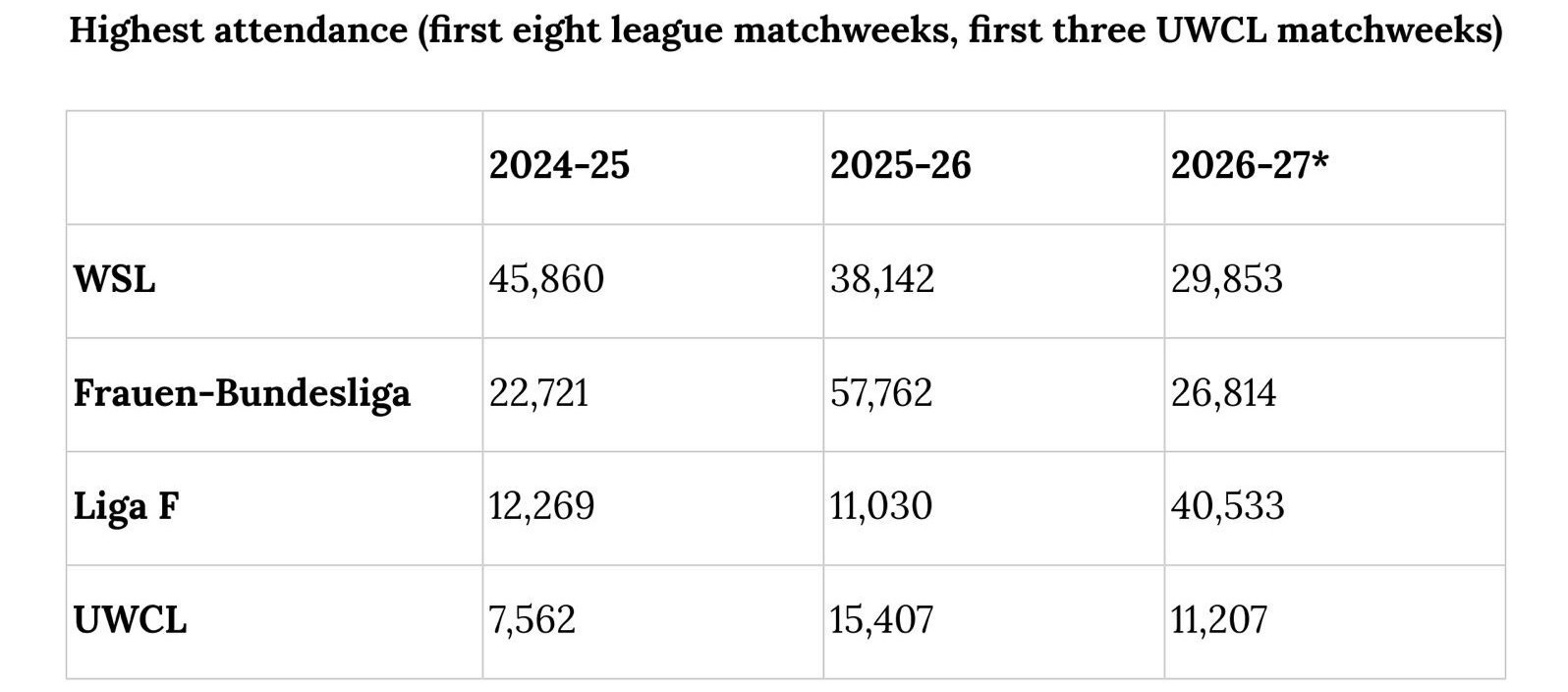
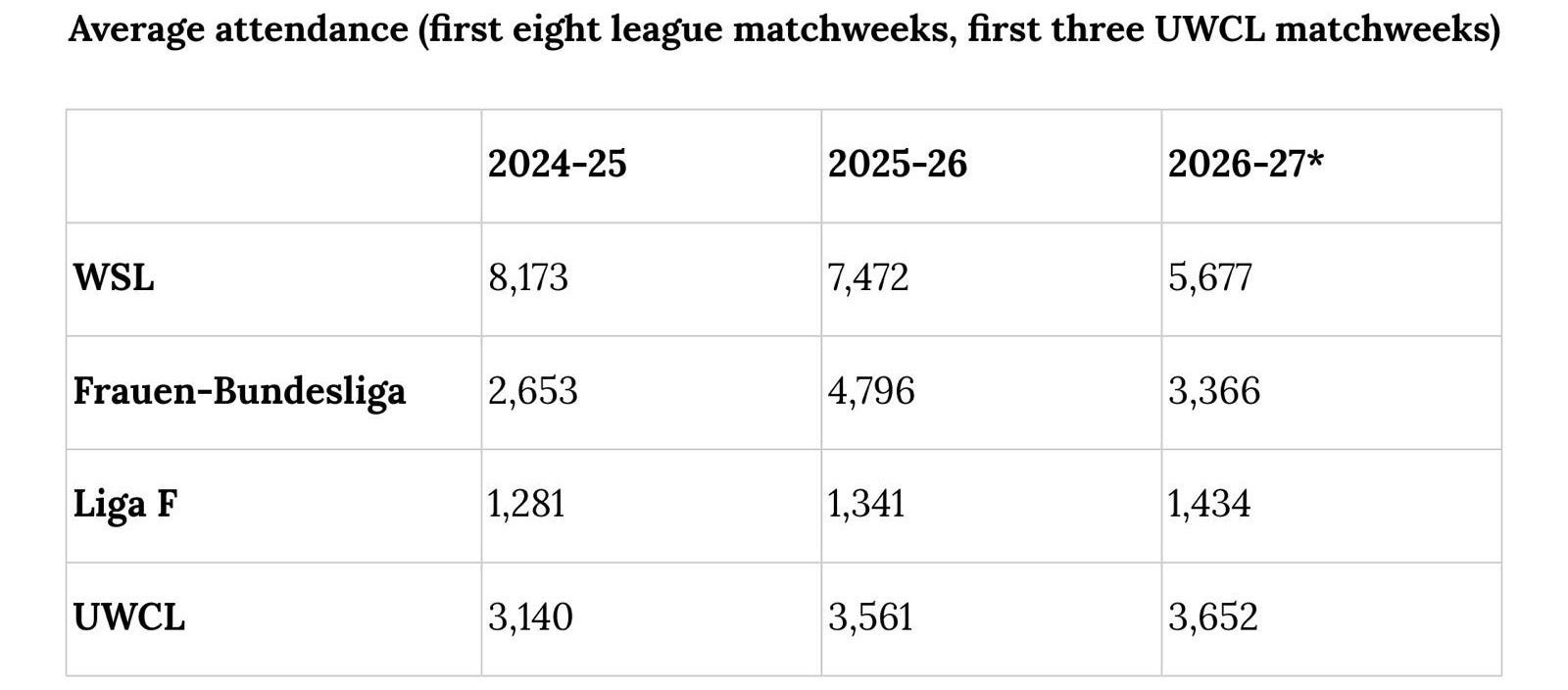
The extraordinary crowds of the late 2010s and early 2020s that distorted women’s football attendance averages — and industry expectations — are becoming less common, but the ordinary match-going audience looks to be solid everywhere other than Spain, despite the marketing efforts of clubs often being pitched at one-off events.
The Cutback’s analysis of attendances over the first eight matchweeks (or three, in the UWCL’s case) across the past three seasons shows that strong average attendance numbers are highly dependent on ‘big match’ crowds, while median attendances — fuelled by hardcore women’s football fans — have remained relatively stable.
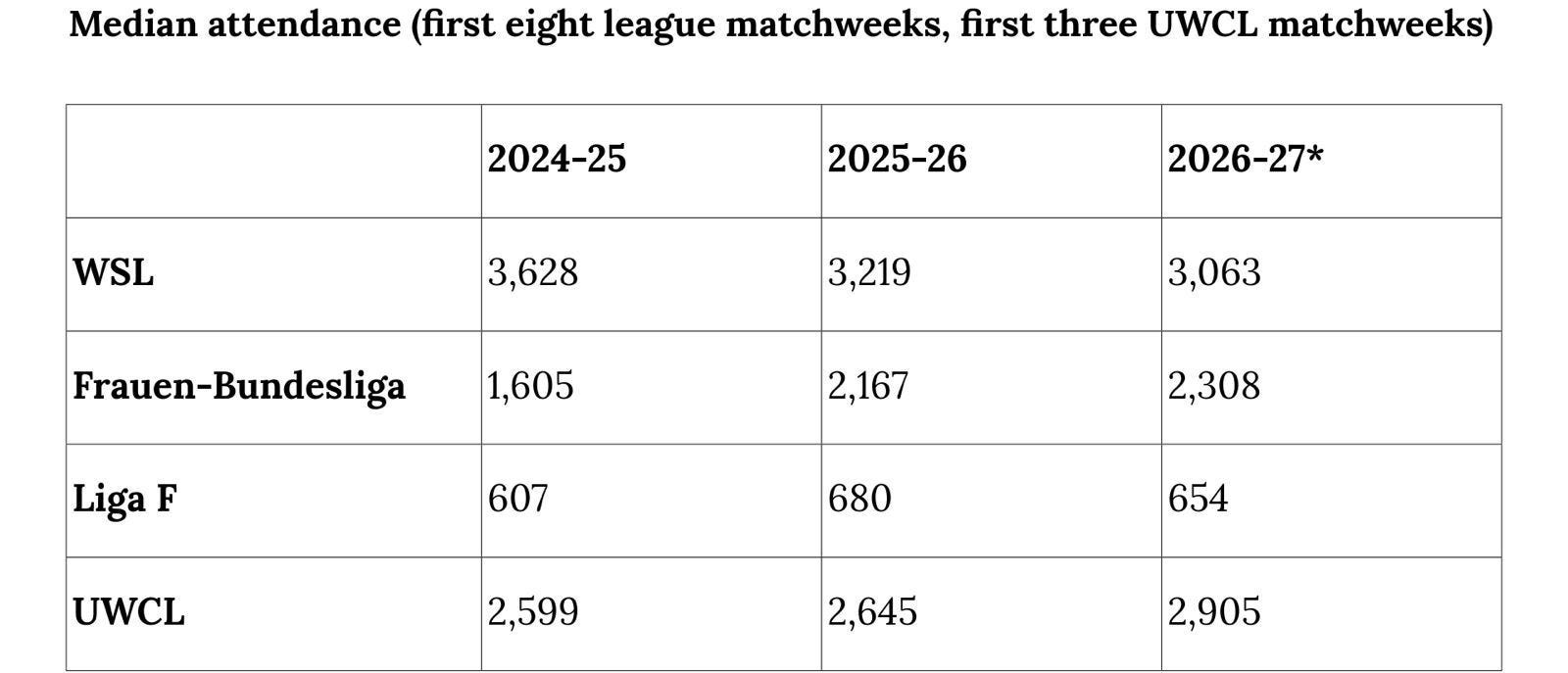
Sources: Women’s Football Data Centre, AS, FBRef, BBC Sport, DFB, Uefa, Liga F, Global Sports Archive, Opta, official club websites
*Eight WSL attendances in 2026-27 are yet to be reported by any reliable source
The data shows there is a reliable, committed audience for women’s football, albeit smaller than many anticipated after Euro 2022. They largely consist of young adults with disposable income as well as those from the LGBTQ community and Premier League football supporters dissatisfied with their experience in the men’s game.
These are all audiences worth cultivating, though they won’t offer the kind of explosive mainstream growth that women’s football executives were pitching a few years back.
Clubs like Arsenal have shown that a long-term effort put towards marketing women’s football can develop a persistent fan culture from within an existing supporter base. The fervour of those fans then becomes attractive to those outside the bubble via word of mouth and osmosis. This is vastly preferable to a transient event audience.
You can decide from the tables above whether women’s football is indeed suffering through a crisis, or whether the game just isn’t paying attention to the right people.
The WSL’s blackout window could be about to close
Should the Scottish Professional Football League succeed in pushing for the elimination of the Saturday 3pm broadcast blackout in the UK, it will come as a blow to the women’s game in England.
The SPFL’s new tender allows broadcasters to make offers on the assumption that Uefa’s Article 48 restrictions, which prevent live football broadcasts between 2.45pm and 5.15pm on Saturdays, will be lifted. Currently, just 82 of the Scottish Premiership’s 228 matches are available for domestic broadcast each season.
The 2023 Karen Carney Review recommended establishing a dedicated television window for women’s football, identifying Saturday at 3pm as the primary opportunity. The government endorsed the recommendation, while the House of Commons Culture, Media and Sport Committee called for an exemption in April.
Any removal or amendment to the blackout would require the agreement of England’s Football Association. The Premier League and EFL are thought to be in favour of the blackout being lifted as selling more matches to broadcasters is their only likely path to increasing media rights income in future deals. However, its unclear whether the Premier League and EFL’s next broadcast tenders would also seek change on Article 48.
The blackout exists to protect lower-league attendances across the UK, where non-league football is unusually popular. In a post-blackout world, the WSL might benefit from being able to use the 3pm kick-off slot from an attendance perspective, but the slot would be functionally useless from a broadcast angle if the league continued to share that space with men’s football.
In any case, it looks increasingly unlikely that the WSL will get the preferential treatment they were looking for.
Fifa falls short of World Cup prize money parity
Fifa is planning to double prize money for the 2027 Women’s World Cup in Brazil to $220m, according to reporting by Sky News and The Guardian.
The proposed allocation would be a substantial increase on the $110m distributed in 2023 and the $30m distributed in 2019, but falls short of president Gianni Infantino’s stated ambition to achieve parity with the men’s tournament.
The men’s World Cup distributed $655m in prize money this year across 48 participating nations. With 32 teams in Brazil, distributing equivalent prize money to each participating nation would require approximately $437m. Fifa’s final allocation will be decided in December.
On 22 October, Fifa confirmed that each participating association will receive $2.5m in preparation funding, increasing the total allocation from $30.7m in 2023 to $80m in 2027. The governing body is also reportedly planning to double its Club Benefits Programme to $22.6m, while minimum guaranteed payments to individual players could increase from $30,000 to $60,000.
Fifa has promised participating players the same travel and accommodation standards as their male counterparts, including business-class flights and individual hotel rooms. Any tournament surplus will be redistributed to participating associations, with a portion reserved for players.
NWSL opens its chequebook as expansion accelerates
The NWSL will allow clubs to pay additional compensation outside the salary cap to a much wider group of players from January 2027, confirming a change first reported by The Cutback in May.
The league’s High Impact Player (HIP) mechanism lets clubs commit an extra $1m annually to eligible players. Originally, eligibility depended on players hitting one of eight criteria, including international appearances, awards and media rankings.
Introduced amid the Washington Spirit’s efforts to retain Trinity Rodman, the HIP rules drew a challenge from the NWSL Players Association, which argued the league had implemented the policy without collective bargaining.
The Cutback revealed in May that the restrictions could be removed and the settlement on 23 October confirmed that any player can now qualify as a HIP, provided their salary meets a threshold equivalent to 12% of the league’s base salary cap.
The amendments give clubs greater freedom to compete for players in an international market in which Europe’s leading sides are increasingly able to outbid US teams on salary.
Globo’s women’s football investment pays off in Brazil
Brazilian women’s football is building a significant television audience ahead of the 2027 World Cup, with Globo reporting that the 2026 Brasileirão Feminino reached over 56 million people across its broadcast and digital platforms, up 14% on last season.
Globo’s free-to-air channels were largely responsible for the reach, as the final between São Paulo and Corinthians reached 23 million people, who watched at least some of a match attended by 49,405 people at MorumBIS.
Globo has invested in regular distribution for women’s club football across free-to-air television and SporTV, with an agreement covering up to ten terrestrial broadcasts and 44 matches on the subscription channel each year. It will also show the 2027 Women’s World Cup, giving domestic clubs an opportunity to build on the tournament’s attention.