FM26: How to win it all in a WSL save
Part three of our writer’s journey brings tense transfer negotiations and two clashes with a rival
Having suffered their first defeat of the Radwan era, Arsenal had little time to dwell on it with the UEFA Women’s Champions League resuming just days later. Looking to manage the squad, I rotated heavily for the opening match of our continental title defence, but the changes disrupted our rhythm. Falling behind early, I was forced to turn to the bench sooner than planned, with several senior players helping rescue a difficult performance in an eventual 5-2 win.
Attention then an unexpected top-3 clash with Brighton, the early surprise package of the Barclays WSL season. With my team showing a defensive brittleness in recent games, there was no question of playing my best XI for this one. This decision paid off with Arsenal going 4-0 up before Brighton hit back with two late consolations.
Then came another UEFA Women’s Champions League match away to Eintracht Frankfurt which would make last week’s seven-goal thriller seem like a snoozefest in comparison. Astonishingly, it was my Arsenal team that came out on top in Germany despite conceding five times. With the scores level at 5-5 with 10 minutes to go, a late Alessio Russo hat-trick secured an 8-5 victory.
Following a routine 4-0 victory away at Leicester, it was now time for a top-of-the-table crunch match against Chelsea. Having conceded two goals in five of our last six matches, I made a tactical tweak for this match and deployed Kyra Cooney-Cross as a defensive midfielder in an asymmetrical 4-2-3-1. I also modified Katie McCabe’s in possession role to playmaking wingback to ensure my team had control of the midfield. As it turned out, McCabe would be the hero on the day, scoring twice in a 3-0 win that saw my team go top of the WSL.
A few days later, we were brought back down to earth, falling victim to two Wolfsburg wonder-strikes in a 2-1 home defeat, despite dominating in terms of chances created. As had been the case after our defeat against Manchester City earlier in the season, the loss didn’t spark a downturn in form. We achieved back-to-back 3-1 victories against Tottenham Hotspur and AS Roma ahead of the international break.
December began with another high-scoring performance as Liverpool were beaten 5-2 at the Emirates, though the same pattern remained clear: dangerous going forward, vulnerable defensively. That concern resurfaced against Bayern Munich in the Champions League league phase. In a match that mirrored Arsenal’s real-life European struggles, we lost 3-2 in an end-to-end contest that effectively condemned us to the play-off round. I attempted to gain more midfield control by switching to a 4-3-3 with a holding midfielder, but the adjustment made little difference.
This setback was followed by a pair of routine wins. A 3-1 defeat of Everton at the iconic Goodison Park which was followed by a 3-1 home victory over Inter Milan in the UEFA Women’s Champions League, thanks to a Stina Blackstenius hat-trick. After a brief holiday over the winter break, the start of 2026 saw the opening of the January transfer window, and a first opportunity for me to bolster the squad. Up to this point, I had favoured a 4-2-3-1 formation. However, my vision had always been to transition to a 4-3-3 formation featuring a lone defensive midfielder, flanked by two number eights. To achieve this, there was one household name that I had earmarked as my number one target. Barcelona’s Patri Guijarro...
Having initially entered talks with the player’s agent to sound out a potential move, I was advised to act quickly before other clubs swooped for signature. Before formally entering negotiations with Barcelona. Having kept my powder dry in the summer, I knew there was money there to be spent which came in handy with Barcelona driving a hard bargain. Eventually, an agreement was made for a world-record fee of £2 million for the player’s services. So crucial was this pursuit to my team’s plans, I was willing to overlook a failed medical that would see the defensive midfielder sidelined through injury for her first month at the club.
Her absence came at an awkward time, with major WSL fixtures against Manchester United and Chelsea arriving almost immediately. United’s trip to the Emirates was our first match of 2026, with Marc Skinner’s side eager for revenge after a 5-0 defeat earlier in the season. Leading 2-1 with 10 minutes to play of what had been a tense match, Frida Maanum was the difference maker with a brace in an eventual 5-1 win.
This was the perfect way to set the scene for the return fixture against Chelsea with both sides boasting perfect records in the league since the previous meeting in November. As had been the case in that match, I adapted my system by approaching the fixture with a little more caution compared to the full-throttle approach that had served me well up until this point.
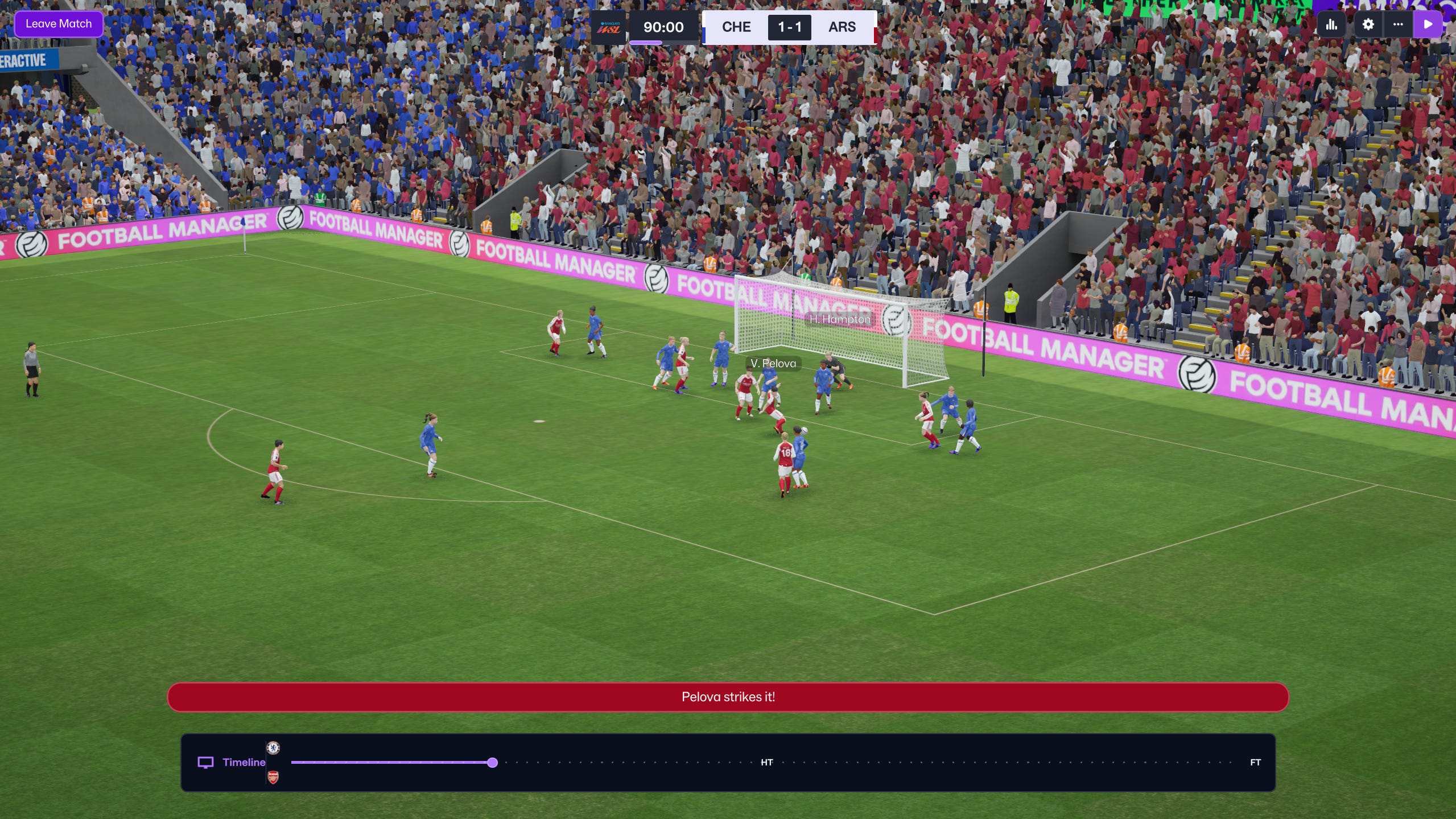
Playing with an out-of-possession defensive midfield pairing of Cooney-Cross and Victoria Pelova, I also instructed my team to play with a lower tempo than usual in order to avoid turnovers. This resulted in one of the tenser matches I’d been involved in this season. In the first half, Pelova reaffirmed her status as a player for the big occasion, opening the scoring on 20 minutes. Looking to sit on the lead rather than go for a second goal, in what was a more restrained performance than usual, my team were ultimately punished for their cautiousness. Sam Kerr levelled with 15 minutes to play, ensuring the points were shared in a 1-1 draw that kept my team’s slender lead in the title race intact.
Despite Arsenal’s strong standing in the WSL table, I was in no position to rest on my laurels, with the last week of the January transfer window proving to be busy in terms of both incomings and outgoings. With a midfield refresh top of my agenda, the world-record breaking signing of Patri was supplemented by a gamble on a future talent. Having set a recruitment focus for high potential midfielders, I made a late transfer offer for Angel City midfielder Kennedy Fuller, with both clubs reaching a £1-million agreement for the Texas native. My remaining business closely resembled Arsenal’s real-life January transfer activity with Smilla Holmberg coming in from Hammarby to provide depth both at right back and on the wing. Jenna Nighswonger was the only permanent departure.
With the transfer window closed, the squad felt equipped to compete across every front. Arsenal sat top of the WSL, remained alive in the Champions League and domestic cups, and were now preparing for the inaugural FIFA Women’s Champions Cup.
Tune into part four to see if an unlikely quintuple is heading to North London...


